Sleep Return Timeout for Unattended Wake Up

How to Change Return to Sleep Timeout for Unattended Wake Up in Windows


   Information
This tutorial will show you how to change how many minutes Windows will wait idle after waking up in an unattended state before automatically going back to sleep or hibernation in Vista, Windows 7, and Windows 8.

   Tip
Adjusting this wait timeout period can also be handy if you had created a task in Task Scheduler to wake up the computer to run something. You could set this wait timeout period to be long enough for the task to have time to finish running before Windows 7 went back to sleep automatically.
   Note
  • If the computer wakes up from sleep mode and is used by you (no longer idle) during this default timeout period, then Windows will not go back to sleep mode automatically after this timeout period. Instead it will use the time period you set in your Power Plan Settings for Sleep or Hibernation.
  • This will also affect how long you have to enter your user account password if you have enabled the Require a Password on wakeup option.
   Warning
You can only do this while logged into an administrator account.


OPTION ONE

To Set System Unattended Sleep Timeout in Power Options

1. If the administrator has not already, the System unattended sleep timeout needs to be added to Advanced Power Settings.

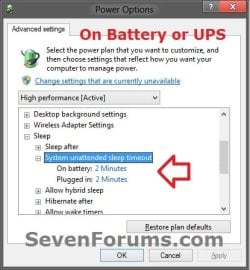
2. Open your Advanced Power Settings, expand Sleep and System unattended sleep timeout. (see screenshots below)

3. Set how many minutes you want, and click/tap on OK. (see screenshots below)AC-Only.jpg Battery.jpg


   Note
This option changes the ACSettingIndex (Plugged in) and/or DCSettingIndex (On battery) DWORD values at the registry location below.

Substitute Your Power Plan Registry Key in the path below with the actual registry key for in the table below instead for the power plan this is for.

Code:
[HKEY_LOCAL_MACHINE\SYSTEM\CurrentControlSet\Control\Power\User\PowerSchemes\[B][COLOR=red]Your Power Plan Registry Key[/COLOR][/B]\238c9fa8-0aad-41ed-83f4-97be242c8f20\7bc4a2f9-d8fc-4469-b07b-33eb785aaca0]

Registry KeyPower Plan
381b4222-f694-41f0-9685-ff5bb260df2eBalanced
8c5e7fda-e8bf-4a96-9a85-a6e23a8c635cHigh performance
a1841308-3541-4fab-bc81-f71556f20b4aPower saver


OPTION TWO

To Set Default System Unattended Sleep Timeout in Registy


NOTE: You can only do this option while logged into an administrator account.1. Press Windows+R to open the Run dialog, type regedit, and click/tap on OK.

2. If prompted by UAC, then click/tap on Yes (Windows 7/8) or Continue (Vista).

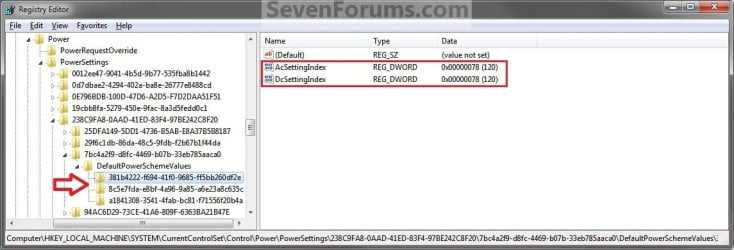
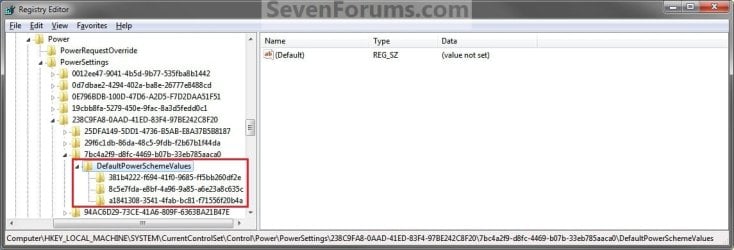
3. In regedit, navigate to the location below: (See screenshot below)

Code:
HKEY_LOCAL_MACHINE\SYSTEM\CurrentControlSet\Control\Power\PowerSettings\238C9FA8-0AAD-41ED-83F4-97BE242C8F20\7bc4a2f9-d8fc-4469-b07b-33eb785aaca0\DefaultPowerSchemeValues
Step1.jpg

4. In the left pane of regedit, double click/tap on the DefaultPowerSchemeValues key (folder) to expand it. (See screenshot above)

5. Click/tap on the key (see table in tip below) that is for the Power Plan that you want to change the default wait time for. (See screenshot above)
NOTE: Normally, you would just do this for the Power Plan that you have selected (see tip below). If you have more than one user, then you may also want to include their Power Plan, or all of them.
   Tip
Registry KeyPower Plan
381b4222-f694-41f0-9685-ff5bb260df2eBalanced
8c5e7fda-e8bf-4a96-9a85-a6e23a8c635cHigh performance
a1841308-3541-4fab-bc81-f71556f20b4aPower saver

NOTE: You will not be able to set the wait timeout period for a custom power plan. You can only do so with the default power plans.


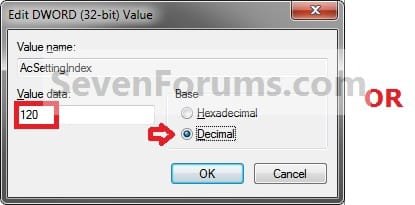
6. In the right pane, double click/tap on ACSettingIndex (Plugged in) or DCSettingIndex (On battery) to Modify it. (See screenshot below)
NOTE: You can choose to do this with one or both of these options to set what you want the wait timeout period to be for them.Step2.jpg

7. Dot Decimal, and type in how many seconds you want Wndows to wait before going back to sleep or hibernation automatically after an unattended wakeup. Click/tap on OK. (See screenshots below)
NOTE: The default time is 120 seconds (2 minutes).Step3A.jpgStep3B.jpg


8. Close regedit.

9. Log off and log on, or restart the computer to apply.


That's it,
Shawn Brink


Attachments

  • Power_Options.jpg
    Power_Options.jpg
    49 KB · Views: 19
Last edited:
Hi Brink,

Thanks for the advice.

I will try to set this up and let you know how it goes.

Once again, thanks for your help.
 

My Computer My Computer

Computer type
PC/Desktop
Computer Manufacturer/Model Number
Alienware
OS
Windows 7
Anytime. I hope it helps. :)
 

My Computer My Computer

Computer type
PC/Desktop
Computer Manufacturer/Model Number
Self built custom
OS
64-bit Windows 11 Pro for Workstations
CPU
Intel i7-8700K OC'd to 5 GHz
Motherboard
ASUS ROG Maximus XI Formula Z390
Memory
64 GB (4x16GB) G.SKILL TridentZ RGB DDR4 3600 MHz
Graphics Card(s)
ASUS ROG-STRIX-GTX1080TI-O11G-GAMING
Sound Card
Integrated
Monitor(s) Displays
2 x Samsung Odyssey G7 27"
Screen Resolution
2560x1440
Hard Drives
1TB Samsung 990 PRO M.2,
4TB Samsung 990 PRO PRO M.2,
TerraMaster F8 SSD Plus NAS
PSU
Seasonic Prime Titanium 850W
Case
Thermaltake Core P3
Cooling
Corsair Hydro H115i
Keyboard
Logitech wireless K800
Mouse
Logitech MX Master 4
Internet Speed
2 Gb/s Download and 100 Mb/s Upload
Antivirus
Malwarebyte Anti-Malware Premium
Browser
Google Chrome
Other Info
Logitech Z625 speaker system,
Logitech BRIO 4K Pro webcam,
HP Color LaserJet Pro MFP M477fdn,
APC SMART-UPS RT 1000 XL - SURT1000XLI,
Galaxy S23 Plus phone
Hi Brink,

I tried to add the "new action" (getting my computer to go back to sleep) to the original task I had set-up in my task scheduler (which was wake the computer up from sleep at 6:30am) as it sometimes did not go back to sleep as scheduled (after the unattended wake up).

It got too complicated so I ended up just making a "new task" in the task scheduler for the computer to go back to sleep at 3:00pm every day as you recommended (given that it sometimes fails to go back to sleep after the 5 hour timeout I changed in the registry via your tutorial).

Unfortunately, using the "rundll32.exe powrprof.dll,SetSuspendState" as the action for the task, it actually makes my computer shut down all together, not go to sleep.

Am I doing something wrong or did I not follow your directions correctly?

Once again, thanks for you help.

Tim
 

My Computer My Computer

Computer type
PC/Desktop
Computer Manufacturer/Model Number
Alienware
OS
Windows 7

My Computer My Computer

Computer type
PC/Desktop
Computer Manufacturer/Model Number
Self built custom
OS
64-bit Windows 11 Pro for Workstations
CPU
Intel i7-8700K OC'd to 5 GHz
Motherboard
ASUS ROG Maximus XI Formula Z390
Memory
64 GB (4x16GB) G.SKILL TridentZ RGB DDR4 3600 MHz
Graphics Card(s)
ASUS ROG-STRIX-GTX1080TI-O11G-GAMING
Sound Card
Integrated
Monitor(s) Displays
2 x Samsung Odyssey G7 27"
Screen Resolution
2560x1440
Hard Drives
1TB Samsung 990 PRO M.2,
4TB Samsung 990 PRO PRO M.2,
TerraMaster F8 SSD Plus NAS
PSU
Seasonic Prime Titanium 850W
Case
Thermaltake Core P3
Cooling
Corsair Hydro H115i
Keyboard
Logitech wireless K800
Mouse
Logitech MX Master 4
Internet Speed
2 Gb/s Download and 100 Mb/s Upload
Antivirus
Malwarebyte Anti-Malware Premium
Browser
Google Chrome
Other Info
Logitech Z625 speaker system,
Logitech BRIO 4K Pro webcam,
HP Color LaserJet Pro MFP M477fdn,
APC SMART-UPS RT 1000 XL - SURT1000XLI,
Galaxy S23 Plus phone
Hi Brink,

I will make the change to the power button in my Power Options settings. Looking at your tutorial POWER BUTTON - START MENU, I assume I should follow "option 2 - "Through Advanced Power Options" to make these changes? ( I want to make sure I am doing this right)

Also, will this be an issue in terms of user accounts?? This "task" will likely run at a time when I am not logged in and I am pretty much the only person/account on my computer.

Thanks,

Tim
 

My Computer My Computer

Computer type
PC/Desktop
Computer Manufacturer/Model Number
Alienware
OS
Windows 7
Tim,

You can set it using either one of the options in the tutorial. They all do the same thing, but just different ways to do so.

It shouldn't make any difference.
 

My Computer My Computer

Computer type
PC/Desktop
Computer Manufacturer/Model Number
Self built custom
OS
64-bit Windows 11 Pro for Workstations
CPU
Intel i7-8700K OC'd to 5 GHz
Motherboard
ASUS ROG Maximus XI Formula Z390
Memory
64 GB (4x16GB) G.SKILL TridentZ RGB DDR4 3600 MHz
Graphics Card(s)
ASUS ROG-STRIX-GTX1080TI-O11G-GAMING
Sound Card
Integrated
Monitor(s) Displays
2 x Samsung Odyssey G7 27"
Screen Resolution
2560x1440
Hard Drives
1TB Samsung 990 PRO M.2,
4TB Samsung 990 PRO PRO M.2,
TerraMaster F8 SSD Plus NAS
PSU
Seasonic Prime Titanium 850W
Case
Thermaltake Core P3
Cooling
Corsair Hydro H115i
Keyboard
Logitech wireless K800
Mouse
Logitech MX Master 4
Internet Speed
2 Gb/s Download and 100 Mb/s Upload
Antivirus
Malwarebyte Anti-Malware Premium
Browser
Google Chrome
Other Info
Logitech Z625 speaker system,
Logitech BRIO 4K Pro webcam,
HP Color LaserJet Pro MFP M477fdn,
APC SMART-UPS RT 1000 XL - SURT1000XLI,
Galaxy S23 Plus phone
Hi Brink,

Unfortunately, despite the changes I made in the power options settings to "sleep", my computer still turns off.

Just to make sure, I tried several of the "simpler" options in your tutorial (options 1, 2, and 3) and did several "trial runs" of the scheduled task and each time, the computer shuts down (NOT sleep).

Any other ideas I should try and consider?? Do you think it is worth deleting the original task in the scheduler and "create" a new task with all the same parameters??
 

My Computer My Computer

Computer type
PC/Desktop
Computer Manufacturer/Model Number
Alienware
OS
Windows 7
Yeah, I'd try starting over to see if there may have been something wrong the first time.
 

My Computer My Computer

Computer type
PC/Desktop
Computer Manufacturer/Model Number
Self built custom
OS
64-bit Windows 11 Pro for Workstations
CPU
Intel i7-8700K OC'd to 5 GHz
Motherboard
ASUS ROG Maximus XI Formula Z390
Memory
64 GB (4x16GB) G.SKILL TridentZ RGB DDR4 3600 MHz
Graphics Card(s)
ASUS ROG-STRIX-GTX1080TI-O11G-GAMING
Sound Card
Integrated
Monitor(s) Displays
2 x Samsung Odyssey G7 27"
Screen Resolution
2560x1440
Hard Drives
1TB Samsung 990 PRO M.2,
4TB Samsung 990 PRO PRO M.2,
TerraMaster F8 SSD Plus NAS
PSU
Seasonic Prime Titanium 850W
Case
Thermaltake Core P3
Cooling
Corsair Hydro H115i
Keyboard
Logitech wireless K800
Mouse
Logitech MX Master 4
Internet Speed
2 Gb/s Download and 100 Mb/s Upload
Antivirus
Malwarebyte Anti-Malware Premium
Browser
Google Chrome
Other Info
Logitech Z625 speaker system,
Logitech BRIO 4K Pro webcam,
HP Color LaserJet Pro MFP M477fdn,
APC SMART-UPS RT 1000 XL - SURT1000XLI,
Galaxy S23 Plus phone
In case that does not work, any other ideas??
 

My Computer My Computer

Computer type
PC/Desktop
Computer Manufacturer/Model Number
Alienware
OS
Windows 7
Not sure either.
 

My Computer My Computer

Computer type
PC/Desktop
Computer Manufacturer/Model Number
Self built custom
OS
64-bit Windows 11 Pro for Workstations
CPU
Intel i7-8700K OC'd to 5 GHz
Motherboard
ASUS ROG Maximus XI Formula Z390
Memory
64 GB (4x16GB) G.SKILL TridentZ RGB DDR4 3600 MHz
Graphics Card(s)
ASUS ROG-STRIX-GTX1080TI-O11G-GAMING
Sound Card
Integrated
Monitor(s) Displays
2 x Samsung Odyssey G7 27"
Screen Resolution
2560x1440
Hard Drives
1TB Samsung 990 PRO M.2,
4TB Samsung 990 PRO PRO M.2,
TerraMaster F8 SSD Plus NAS
PSU
Seasonic Prime Titanium 850W
Case
Thermaltake Core P3
Cooling
Corsair Hydro H115i
Keyboard
Logitech wireless K800
Mouse
Logitech MX Master 4
Internet Speed
2 Gb/s Download and 100 Mb/s Upload
Antivirus
Malwarebyte Anti-Malware Premium
Browser
Google Chrome
Other Info
Logitech Z625 speaker system,
Logitech BRIO 4K Pro webcam,
HP Color LaserJet Pro MFP M477fdn,
APC SMART-UPS RT 1000 XL - SURT1000XLI,
Galaxy S23 Plus phone
Another question for you, Brink:

I can't figure out a way for my computer to force back to sleep, is there a way to make my computer wake-up (from a shut down state) at a specific time?? If you have a tutorial regarding this, let me know but I don't think I saw one.

The reason I ask is that if I can wake-up my computer from a shut down state and clearly have way to force it shut down, this may be a work around. However, this somewhat works against the whole point of putting the computer in a sleep state.

Thanks.
 

My Computer My Computer

Computer type
PC/Desktop
Computer Manufacturer/Model Number
Alienware
OS
Windows 7
kanungos

You mentioned that the rundll32.exe powrprof.dll,SetSuspendState command shuts down your PC. Are you referring to a complete PC shutdown where you need to push your PC's power button in order to power up your PC after using rundll32.exe powrprof.dll,SetSuspendState ?

I'm wondering if your PC is actually getting put into 'hibernate' mode. I have both of my Win 7x64 PC's 'hibernate' option disabled and have been using a "forced Sleep" action without problems for about 3 years.

You might try disabling 'hibernate' in a CMD window. That usually needs to be disabled in order for the rundll32.exe powrprof.dll,SetSuspendState command to put the PC to Sleep mode (instead of 'hibernate' mode) if run from within a batch job or possibly the Task Manager.

To disable 'hibernate', open an elevated CMD window.

At the CMD prompt, enter this to check your current Sleep/Hibernate PC states:

powercfg -a

You should see something like this returned in system information. Here's my Desktop PC's current info when I use the "powefcfg -a" query:

The following sleep states are available on this system: Standby ( S1 S3 )
The following sleep states are not available on this system:
Standby (S2)
The system firmware does not support this standby state.
Hibernate
Hibernation has not been enabled.
Hybrid Sleep


if your 'hibernate' option is enabled, you can disable it with this command:

powercfg -h off


If my memory's working right, the rundll32.exe powrprof.dll,SetSuspendState requires the 'hibernate off' command to be included in a batch file in order for the command to put the PC into Sleep mode and not 'Hibernate' mode. That also requires the batch file to be run in "Admin" (elevated" mode.


Another option for you to use with Task Scheduler to force the PC to Sleep mode, is to use a free utility from one of the "Sysinternals" tools called "psshutdown".

Here's the link to the "psshutdown" download site that can be used to do what you're wanting to do with your PC.

psshutdown v2.52

It's a standalone .exe file that can use used to put the PC to Sleep mode with a batch file or a Task in Task Manager.

The "-d" parameter is the one that puts the PC to Sleep mode.

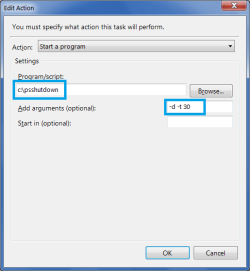
For example, included is a screencap from a "Sleep Test" task that I created and tested on my PC.

I have my "psshutdown" exe file in my top C: directory so I entered that in the "program/script" field.

Then you add the "-d" parameter in the "add arguments" field.

The "-t 30" parameter is a time-delay (30 seconds in this example) that you can use to delay the psshutdown exe file from putting the PC to sleep. I think the default time delay value is 20 seconds.

I ran this Task in my Win Task Scheduler a couple of times and it worked ok.


I've been running my "Sleep" task another way using a freeware hotkey/script program called "AutoHotKey". Within AutoHotkey, there's a command that will put the PC to sleep:

DllCall("PowrProf\SetSuspendState", "int", 0, "int", 0, "int", 0)

I'm using it in a way that's similar to what may be what you're wanting to do with your PC.

For example,

I have a daily specific-item backup job that runs unattended at 12:00pm on my PC. The job takes about 1-2 minutes to complete.

At 12:05pm, my "Sleep" task runs which puts the PC back to sleep. I've been running this for about 3 years without issue.
 

Attachments

  • Task Actions.png
    Task Actions.png
    10 KB · Views: 1,638

My Computer My Computer

Computer type
PC/Desktop
Computer Manufacturer/Model Number
Built at Micro Center Richardson, TX
OS
Windows 7 Home Premium 64 bit
CPU
Intel i5 650 Dual Core 3.20 GHz Cache 4MB Threads: 4
Motherboard
ASUS PRO P7P55D-E
Memory
Corsair 16GB DDR3 1600MHz 9-9-9-24 P/N: CMZ8GX3M2A1600C
Graphics Card(s)
ZOTAC GeFORCE 9500 ZT-95TEK2M-FSL 1GB GDDR2
Sound Card
Mother Bd
Monitor(s) Displays
ASUS V228H 21.5” Diag
Screen Resolution
1440 x 900
Hard Drives
SEAGATE BARRACUDA (2ea) 3.5” INTERNAL 1Tb 16 MB SATA ST1000DM003-9YN162 7200RPM, 64MB, SATA 6Gb/s ** 2 Sata Hot-Swap Racks installed in Tower
PSU
Thermaltake Model TR2 RX 750W
Cooling
2 Tower Fans
Keyboard
Dell Quietkey PS/2 Windows 104 P/N 0463CD
Mouse
Kensington Mechanical Trackball USB Model 64217
Internet Speed
35/35
Antivirus
Norton 360 & MBAM Pro
Browser
IE10
Other Info
Printer: HP DeskJet 3520 USB 2.0 **
Speakers: ALTEC Model VS4621 2.1 28 W/Channel w/Sub-woofer **
IOGEAR HDMI Monitor Switcher Swx3 MODEL GHDSW3 ** Addonics ZDRWESU3 eSata/USB 3.0 external DVD Read/Write DVD Drive** SEAGATE GoFlex USB 2.0 Portable HD 500GB 5400 RPM P/N: 9ZF2A2-570
Hi Scoop,

Thanks for your reply.

In answer to your first question, as far as I can tell, it appears to be a complete shut down of my PC when rundll32.exe powrprof.dll,SetSuspendState "task" runs via my Windows Task Scheduler -- I do need to push the power button to get the PC going again.

Should I still try and disable the hibernation option and see what happens?

If that fails, should I then consider your "psshutdown" and "autohotkey" options??

Let me know and thanks for your advice once again.

Tim
 

My Computer My Computer

Computer type
PC/Desktop
Computer Manufacturer/Model Number
Alienware
OS
Windows 7
Tim,

That's strange, the PC shutting down using rundll32.exe powrprof.dll,SetSuspendState .

I've never seen that occur with my Desktop PC. My Laptop PC is a backup PC so I'm not using it much to test things like this but I got curious about it and tried it on my Laptop PC. The results are interesting.

Is your PC a Desktop or Laptop? If it's a Laptop, then the 'hibernate' mode being enabled may be what you're seeing as I just ran a test on my Laptop PC (Toshiba Laptop) with 'hibernate' disabled and enabled using the rundll32.exe powrprof.dll,SetSuspendState command. Here are the results:

I opened a CMD window and disabled 'hibernate' mode in CMD.

I then entered the rundll32.exe powrprof.dll,SetSuspendState command in the CMD window.

The PC went into normal Sleep mode, requiring any key pressed, etc, to awaken the PC. (PC power button not required to awaken the PC).

After awakening the PC, I enabled 'hibernate' on my Laptop PC and repeated the rundll32.exe powrprof.dll,SetSuspendState test in CMD .

The PC went into 'hibernate' mode which required the power button on the Laptop to be pressed to wake the PC (take it out of 'hibernate' state) since 'hibernate' is sort of like a partial restart, as the PC's environment is saved to the HDD when invoking the 'hibernate' mode so any workspace/windows, etc, that were open and in use at the time the PC went into 'hibernate' state, will be resumed once the PC is awakened.


This is why I like using my AutoHotKey script since the rundll... command is dependent on the 'hibernate' state and the Sleep script command is not dependent on whether 'hibernate' is enabled or disabled.


If the CMD (rundll...) test still shuts down the PC instead of going into Sleep mode, you might want to verify that the manual interactive "sleep" function is working ok on your PC (see next).

Does your PC go into Sleep mode and not shut down when you click on the Sleep option from your Start menu power button?

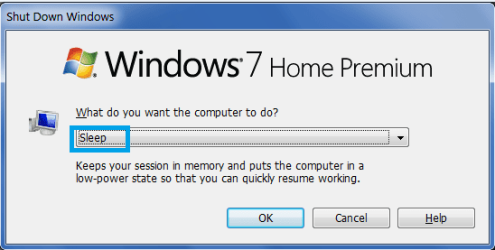
You can also verify the Sleep mode from the Windows Shutdown Menu like this:

- Put your PC in Desktop/active mode (close all other apps, windows).

- Hold down the <alt> key while pressing the F4 key. You should see the Windows Shutdown Menu appear (see included screencap).

- Select the Sleep Mode and verify that your PC goes into Sleep and not a complete shutdown state.

If that works ok, you might try the "psshutdown" download exe file.

Once you have extracted the zip folder download, you'll see several files in the folder. Move just the "psshutdown" exe file into your C: directory.

To test the Sleep mode using psshutdown,

- Open an elevated CMD window.

- Disable "hibernate" mode if it's not already disabled:

hibernate -h off

Enter this at the CMD prompt:

cd \ (this changes your default directory location in CMD to your C: directory where your psshutdown file is located).

Then, enter this:

psshutdown -d -t 30

Your PC should go into Sleep mode in 30 seconds.

If that works, that should verify that the basic "sleep" command and your power configurations are working ok.

it should also then work from within the Task Manager as a Task.
 

Attachments

  • shutdown menu.png
    shutdown menu.png
    11.7 KB · Views: 1,617

My Computer My Computer

Computer type
PC/Desktop
Computer Manufacturer/Model Number
Built at Micro Center Richardson, TX
OS
Windows 7 Home Premium 64 bit
CPU
Intel i5 650 Dual Core 3.20 GHz Cache 4MB Threads: 4
Motherboard
ASUS PRO P7P55D-E
Memory
Corsair 16GB DDR3 1600MHz 9-9-9-24 P/N: CMZ8GX3M2A1600C
Graphics Card(s)
ZOTAC GeFORCE 9500 ZT-95TEK2M-FSL 1GB GDDR2
Sound Card
Mother Bd
Monitor(s) Displays
ASUS V228H 21.5” Diag
Screen Resolution
1440 x 900
Hard Drives
SEAGATE BARRACUDA (2ea) 3.5” INTERNAL 1Tb 16 MB SATA ST1000DM003-9YN162 7200RPM, 64MB, SATA 6Gb/s ** 2 Sata Hot-Swap Racks installed in Tower
PSU
Thermaltake Model TR2 RX 750W
Cooling
2 Tower Fans
Keyboard
Dell Quietkey PS/2 Windows 104 P/N 0463CD
Mouse
Kensington Mechanical Trackball USB Model 64217
Internet Speed
35/35
Antivirus
Norton 360 & MBAM Pro
Browser
IE10
Other Info
Printer: HP DeskJet 3520 USB 2.0 **
Speakers: ALTEC Model VS4621 2.1 28 W/Channel w/Sub-woofer **
IOGEAR HDMI Monitor Switcher Swx3 MODEL GHDSW3 ** Addonics ZDRWESU3 eSata/USB 3.0 external DVD Read/Write DVD Drive** SEAGATE GoFlex USB 2.0 Portable HD 500GB 5400 RPM P/N: 9ZF2A2-570
Hi Scoop,

Actually you were right -- my computer was going into "hibernate" mode with the rundll32.exe powrprof.dll,SetSuspendState command. I really have never used hibernate for much of anything since this is all being done on my Desktop.

Hibernation appears very similar to shutdown to the untrained eye (like me!)

Anyway, I disabled the hibernation mode in the elevated CMD and now things seem to be working as they should be with my computer going into sleep mode.

Another question for you -- will there be any issue or problem with keeping the hibernation mode disabled on my Desktop PC?? As I said, I seen the benefit of the mode on a laptop but not much so on a Desktop.

Thanks.

Tim
 

My Computer My Computer

Computer type
PC/Desktop
Computer Manufacturer/Model Number
Alienware
OS
Windows 7
Tim,

Glad it's working ok now.

Here's a link to one of Shawn's ("Brink") tutorials at this site that explains the differences with the "Sleep" states and "Hibernate".

http://www.sevenforums.com/tutorials/153968-sleep-states-see-available-sleep-states.html

As for "Hibernate", I don't use it myself because I'm always at "Desktop/idle" mode when I invoke Sleep interactively or unattended with a Task or script.

Since all of my apps/windows, etc, are closed when Sleep is launched, the Hibernate option isn't needed for my PC habits since I don't require my PC's environment to be saved to the HDD in the event of a power interruption occurring with my PC.

if you routinely close your apps/files, etc, before you leave your PC (before you use the Sleep mode), then Hibernate isn't required from my POV.

I've had my Hibernate disabled on my Desktop since 2010 without issues.

I left it enabled on my Laptop but I don't use it as I also close any activities before invoking Sleep mode.

"Untrained eye".... don't be concerned about that :). My "eye" is about as trained as a gnat compared to many contributors at this forum :D
 

My Computer My Computer

Computer type
PC/Desktop
Computer Manufacturer/Model Number
Built at Micro Center Richardson, TX
OS
Windows 7 Home Premium 64 bit
CPU
Intel i5 650 Dual Core 3.20 GHz Cache 4MB Threads: 4
Motherboard
ASUS PRO P7P55D-E
Memory
Corsair 16GB DDR3 1600MHz 9-9-9-24 P/N: CMZ8GX3M2A1600C
Graphics Card(s)
ZOTAC GeFORCE 9500 ZT-95TEK2M-FSL 1GB GDDR2
Sound Card
Mother Bd
Monitor(s) Displays
ASUS V228H 21.5” Diag
Screen Resolution
1440 x 900
Hard Drives
SEAGATE BARRACUDA (2ea) 3.5” INTERNAL 1Tb 16 MB SATA ST1000DM003-9YN162 7200RPM, 64MB, SATA 6Gb/s ** 2 Sata Hot-Swap Racks installed in Tower
PSU
Thermaltake Model TR2 RX 750W
Cooling
2 Tower Fans
Keyboard
Dell Quietkey PS/2 Windows 104 P/N 0463CD
Mouse
Kensington Mechanical Trackball USB Model 64217
Internet Speed
35/35
Antivirus
Norton 360 & MBAM Pro
Browser
IE10
Other Info
Printer: HP DeskJet 3520 USB 2.0 **
Speakers: ALTEC Model VS4621 2.1 28 W/Channel w/Sub-woofer **
IOGEAR HDMI Monitor Switcher Swx3 MODEL GHDSW3 ** Addonics ZDRWESU3 eSata/USB 3.0 external DVD Read/Write DVD Drive** SEAGATE GoFlex USB 2.0 Portable HD 500GB 5400 RPM P/N: 9ZF2A2-570
Hi Scoop (or Brink if your still reading):

I have another question for you:

Since the rundll32.exe powrprof.dll,SetSuspendState command has been working as it should via my Windows Task Scheduler, I have noted something a little odd -- after the command has run, and later on, I "wake" my computer up (hit the keyboard or click on the mouse) and then leave it idle, it FAILS TO GO BACK TO SLEEP. My power plan is balanced and is set to go back to sleep after 15 minutes; however, it seems that IT IS NOT GOING BACK TO SLEEP after the 15 minutes elasped time.

My understanding of what should happen is what Brink said at that the beginning of this original tutorial:

"If the computer wakes up from sleep mode and is used by you (no longer idle) during this default timeout period, then Windows will not go back to sleep mode automatically after this timeout period. Instead it will use the time period you set in your Power Plan Settings for Sleep or Hibernation"

Do you actually have to "work" on the computer (ie log in and then email, internet surf...etc) AND THEN LEAVE IT IDLE for the computer to fall back asleep or is there something else I am missing.

As always, thanks for your help.

Tim
 

My Computer My Computer

Computer type
PC/Desktop
Computer Manufacturer/Model Number
Alienware
OS
Windows 7
Hey Tim,

Used basically means any activity caused by the user. This could be as simple as the mouse moved. Say by a cat playing with it. ;)
 

My Computer My Computer

Computer type
PC/Desktop
Computer Manufacturer/Model Number
Self built custom
OS
64-bit Windows 11 Pro for Workstations
CPU
Intel i7-8700K OC'd to 5 GHz
Motherboard
ASUS ROG Maximus XI Formula Z390
Memory
64 GB (4x16GB) G.SKILL TridentZ RGB DDR4 3600 MHz
Graphics Card(s)
ASUS ROG-STRIX-GTX1080TI-O11G-GAMING
Sound Card
Integrated
Monitor(s) Displays
2 x Samsung Odyssey G7 27"
Screen Resolution
2560x1440
Hard Drives
1TB Samsung 990 PRO M.2,
4TB Samsung 990 PRO PRO M.2,
TerraMaster F8 SSD Plus NAS
PSU
Seasonic Prime Titanium 850W
Case
Thermaltake Core P3
Cooling
Corsair Hydro H115i
Keyboard
Logitech wireless K800
Mouse
Logitech MX Master 4
Internet Speed
2 Gb/s Download and 100 Mb/s Upload
Antivirus
Malwarebyte Anti-Malware Premium
Browser
Google Chrome
Other Info
Logitech Z625 speaker system,
Logitech BRIO 4K Pro webcam,
HP Color LaserJet Pro MFP M477fdn,
APC SMART-UPS RT 1000 XL - SURT1000XLI,
Galaxy S23 Plus phone
Back
Top