Dual Boot Installation with Windows 7 and XP

How to Setup a Dual Boot Installation with Windows 7 and XP


   Information
This will show you how to install Windows 7 and XP to dual boot with when you already have either Windows 7 or XP installed first.
   Note
With a dual boot installaton, you will have two operating systems (OS) installed. When you start the computer, you will have the choice to choose which OS you would like to start up to. This method is the easiest way of doing a dual boot with these two operating systems.
   Tip
When dual booting with another OS (ex: Vista or XP), you may not always have that OS partition show up in Computer with a driver letter in Windows 7. If this happens, then you will just need to add a drive letter to the OS (ex: Vista or XP) partition in Windows 7 Disk Management for it to show up in Computer with a driver letter.
   Warning
To stop XP from deleting your Windows 7 System Restore Points everytime XP is started, then see System Restore Points - Stop XP Dual Boot Delete to hide Windows 7 from XP.

Windows 7 Minimum Hardware Requirements


NOTE: For more information on this, see: Windows 7 system requirements
  • 1 GHz 32-bit or 64-bit processor
  • 1 GB RAM for 32-bit Windows 7 OR 2 GB RAM for 64-bit Windows 7
  • 16 GB available disk space 32-bit Windows 7 OR 20 GB for 64-bit Windows 7
  • Support for DirectX 9 graphics with 128 MB memory (in order to enable Aero theme)
  • DVD-R/W Drive
  • Internet or phone access to activate Windows 7.
Windows XP Minimum Hardware Requirements

NOTE: For more information on this, see: System requirements for Windows XP operating systems
  • PC with 300 megahertz (MHz) or higher processor clock speed recommended; 233-MHz minimum required;* Intel Pentium/Celeron family, AMD K6/Athlon/Duron family, or compatible processor recommended
  • 128 megabytes (MB) of RAM or higher recommended (64 MB minimum supported; may limit performance and some features)
  • 1.5 gigabyte (GB) of available hard disk space.*
  • Super VGA (800 × 600) or higher resolution video adapter and monitor
  • CD-ROM or DVD drive
  • Keyboard and Microsoft Mouse or compatible pointing device
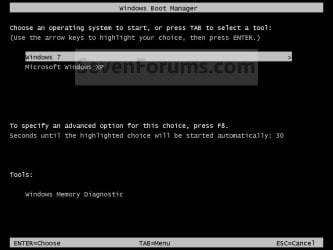
EXAMPLE: Windows Boot Manager
NOTE: This is the boot screen where you select what operating system that you would like to start. By default, you have 30 seconds to choose another operating system before the default operating system will start automatically.
Example.jpg


OPTION ONE

When XP is Installed First


NOTE: If you have a RAID setup, you will need to have the Windows 7 RAID drivers on a USB flash drive available to select and load while installing Windows 7.
1. Do step 2 or 3 below for where you wanted to install Windows 7 at.

2. To Create a New Partition from the XP Hard Disk Drive
A) With your Windows 7 installation disc boot into the Command Prompt from the System Recovery Options screen.
NOTE: Make sure that the CD/DVD drive is selected first in the boot order in the BIOS.

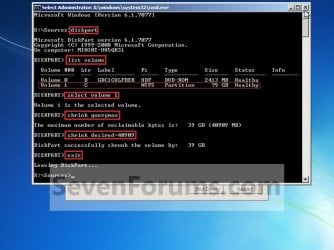
B) In the command prompt, select and shrink the XP volume by how many MB (1024 MB = 1 GB) you want to have for this Windows 7 partition. (See screenshot below)
NOTE: You would do steps 2 to 9 in METHOD TWO at that link. Windows 7 will need a minimum of 16 GB (16384 MB).
XP-W7_1.jpg
C) Click on the X at the top right corner to close the command prompt. (See screenshot above)

D) Click on the X at the top right corner to close System Recovery Options. (See screenshot below)
XP-W7_2.jpg
E) Go to step 4.
3. To Use a Separate Hard Disk Drive than the XP Drive
A) Boot from your Windows 7 installation disc.
NOTE: Make sure that the CD/DVD drive is selected first in the boot order in the BIOS.
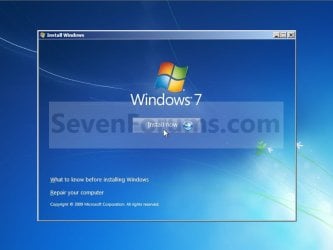
4. Click on the Install now button. (See screenshot below)
XP-W7_3.jpg
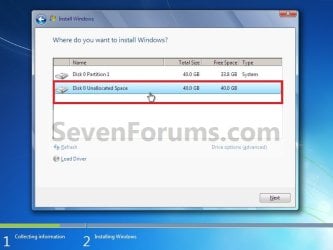
5. When you get to this point, select the partition (step 2) or hard drive to install Windows 7 on. (See screenshot below)
XP-W7_4.jpg
6. Finish installing Windows 7.
NOTE: You would start at step 9 in that link to finish installing Windows 7.

7. When finished, restart the computer to have the option to boot from XP (Earlier Verision of Windows) or Windows 7. (See screenshot below)

   Note
If you are only booting into Windows 7 and do not have XP listed in the Windows Boot Manager, then you can install only EasyBCD (step 8 Option Two below) to add XP (or Windows 7) while started in Windows 7 the same way to the boot list.

Example.jpg


OPTION TWO

When Windows 7 is Installed First


   Warning

1. To Create a New Partition from the Windows 7 Hard Disk Drive
NOTE: If you want to install XP on a separate internal hard drive instead, then skip this step and go to step 2.
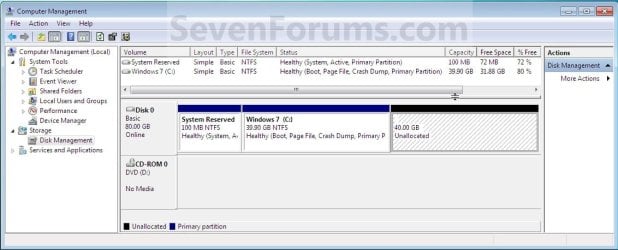
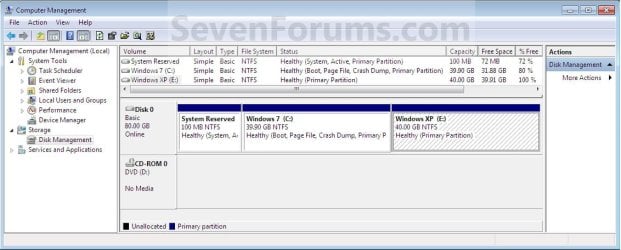
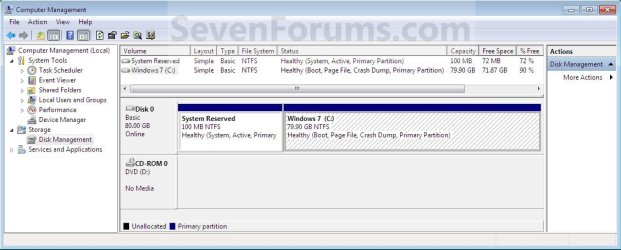
A) In Windows 7, select and shrink the Windows 7 volume in Disk Management by how many MB (1024 MB = 1 GB) you want to have for this XP partition. (See screenshots below)
NOTE: You would do all of Method One at that link.
W7-XP-1.jpg

W7-XP-2.jpg

W7-XP-3.jpg
2. Insert your XP installation disc, then restart the computer and press any key to boot from it when prompted. (See screenshot below)
NOTE: Make sure that the CD/DVD drive is selected first in the boot order in the BIOS.

Step1.jpg
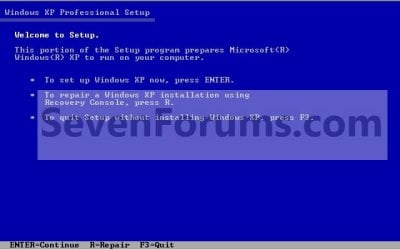
3. From XP Setup, Press Enter. (See screenshot below)


   Warning

W7-XP-4.jpg
4. Press F8. (See screenshot below)
NOTE: On some multimedia keyboards, you may need to press the F-Lock or Function key before pressing F8.
W7-XP-5.jpg
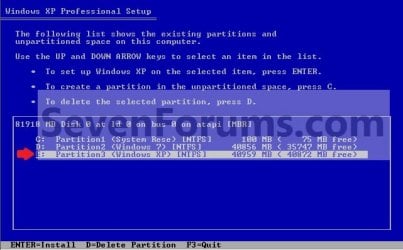
5. Select the partition (step 1) or hard drive that you want to install XP on using the arrow keys and press Enter.
W7-XP-6.jpg
6. Finish installing XP.


   Tip
If you get Error loading Operating System after XP restarts:
  • Using your Windows 7 installation disc, boot to the command prompt at startup.
  • Type in these comands below, and press enter after each one.
    • bootrec /FixMbr
    • bootrec /FixBoot
    • bootrec /RebuildBcd
  • Exit the command prompt and restart the computer.
  • At this point, Windows 7 should boot up the same way before trying to install XP.
  • Continue to step 8 below and run EasyBCD from Windows 7 instead.

7. In XP, download and install .Net Framework 2.0 (32-bit) version or .Net Framework 2.0 (64-bit) version first, and EasyBCD (free version) for your 32-bit (x86) or 64-bit (x86) XP.
NOTE: In XP, Net Framework is required to be installed to run EasyBCD. After you click on Register (at bottom of link) for the free EasyBCD, registration is not required to download it.

8. Run EasyBCD (free version).
NOTE: This is required to repair the Windows 7 boot file and add XP to the Windows Boot Manager list.

9. On the left side of EasyBCD, click on the Add New Entry button. (See screenshot below)
A) In the top section under Operating Systems, click on the Windows tab. (See screenshot below)
B) To the right of Type, select Windows NT/2k/XP/2k3 from the drop down menu. (See screenshot below)
:warn:WARNING: Be sure to leave the Automatically detect correct drive box checked.

C) To the right of Name, you can leave the default Microsoft Windows XP as the name to be displayed in the Windows Boot Manager, or you can type whatever name you would like to have instead. (See screenshot below)
D) Click on the Add Entry button. (See screenshot below)
W7-XP-7.jpg
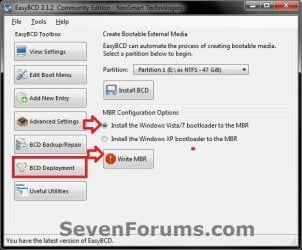
10. On the left side of EasyBCD, click on the BCD Deployment button, select (dot) the Install the Windows Vista/7 bootloader to the MBR option, and click on the Write MBR button. (See screenshot below)
W7-XP-9.jpg
11. Close EasyBCD.

12. Restart the computer to have the option to boot from Microsoft Windows XP or Windows 7. (See screenshot below)
Example2.jpg
   Tip
If Windows 7 will not start up when selected, then use your Windows 7 installation DVD to do a Startup Repair.

That's it,
Shawn


Last edited:
The drives become intentionally relative to whichever OS is booting at the moment as C, as will their links.

I would not worry about it but see how it proceeds and report back any problems.

You cannot change an OS drive letter without ruining the OS.

You really didn't need to create a Windows-managed Dual Boot with separate HD's as it interlocks the HD's requiring surgery to later remove one. If you'd left them booted via either the BIOS Boot Order or One-Time BIOS Boot menu key they would have remained independent to come and go as you please.
 
Hi Greg

Yeah. you are right. But I think with the only dual boot menu being in Win7, it does not affect the WinXP boot process. If it does, I've got ntdlr and the other system files backed up. That's usually what happens when the MS dual boot arrangement gos haywire

What I was doing was disconnect power to one of the drives before the dual boot, but it became a hassle

I think I'll just load up osloader OSL2000 Boot Manager - An Advanced Multi Boot Manager to the Win7 drive, because it can do a hide on the XP partition and then get the drive letters back in order. its not a true hide but nothing is. Eventually, the XP will be gone anyway

Thanks for your advice. If anyone else can weigh in on this, please do.
 

My Computer

OS
Windows 7 32

My Computer

Computer Manufacturer/Model Number
Acer
OS
Windows 7 Ultimate (32bit) and Windows XP pro SP3
CPU
Dual Core
Motherboard
Asus
Memory
2 GB
Hi Bare Foot Kid and Greg,

Thanks both of u very much. I managed to fix my problem. After C became system drive, I used EasyBCD2.1 and first deleted the windows xp entry and re-entered it again. It was so simple...lol! Everything fine now. I can use both my OS and without reinstalling or reparing them...Thank u very much for your tips and helps...
 

My Computer

Computer Manufacturer/Model Number
Acer
OS
Windows 7 Ultimate (32bit) and Windows XP pro SP3
CPU
Dual Core
Motherboard
Asus
Memory
2 GB
Hi Bare Foot Kid and Greg,

Thanks both of u very much. I managed to fix my problem. After C became system drive, I used EasyBCD2.1 and first deleted the windows xp entry and re-entered it again. It was so simple...lol! Everything fine now. I can use both my OS and without reinstalling or reparing them...Thank u very much for your tips and helps...


Hello again.


Good to see you got it sorted and thanks for the update.
 

My Computer

Computer Manufacturer/Model Number
* BFK Customs *
OS
W 7 64-bit Ultimate
CPU
Intel Q9550 Yorkfield
Motherboard
ASUS P5Q Pro
Memory
8GB Dominator 8500C5D
Graphics Card(s)
ATI : XFX 5870
Sound Card
Realtek HD Audio 7-1
Monitor(s) Displays
1x 47" LCD HDMI & 3x 26" LCD HDMI
Screen Resolution
1920x1080P & 1920x1200
Hard Drives
1x 80GB Intel X25-M G2 SSD : 1x 500GB & 1x 640GB WD Caviar Black(s)
PSU
Corsair 620HX
Case
Cooler Master RC-690
Cooling
Tuniq Tower 120, 2x 140mm and 3x 120mm case fans
Keyboard
Microsoft 500
Mouse
Razer Diamondback 3G
Internet Speed
14 Mb/s
Other Info
1x Koutech 3Gb/s SATA HDD Hot Swap Rack
The drives become intentionally relative to whichever OS is booting at the moment as C, as will their links.

I would not worry about it but see how it proceeds and report back any problems.

You cannot change an OS drive letter without ruining the OS.

You really didn't need to create a Windows-managed Dual Boot with separate HD's as it interlocks the HD's requiring surgery to later remove one. If you'd left them booted via either the BIOS Boot Order or One-Time BIOS Boot menu key they would have remained independent to come and go as you please.

Hi Greg

Yeah. you are right. But I think with the only dual boot menu being in Win7, it does not affect the WinXP boot process. If it does, I've got ntdlr and the other system files backed up. That's usually what happens when the MS dual boot arrangement gos haywire

What I was doing was disconnect power to one of the drives before the dual boot, but it became a hassle

I think I'll just load up osloader OSL2000 Boot Manager - An Advanced Multi Boot Manager to the Win7 drive, because it can do a hide on the XP partition and then get the drive letters back in order. its not a true hide but nothing is. Eventually, the XP will be gone anyway

Thanks for your advice. If anyone else can weigh in on this, please do.

You can use the BIOS Boot menu F key opsion.

GA BIOS2.PNG
 

My Computer

OS
ME/XP/Vista/Win7
You can use the BIOS Boot menu F key opsion.
From Jgregory:

I have a different bios/cmos. but usually a Boot Menu saved in cmos is just a hard disk priority sequence. Not a boot loader on the hard drive, so not really the same thing as ability to hide the other Active partition

My main issue was the other OS partition showing up and screwing up my drive letters and paths. I could not change paths in 250 softwares away from D:\

Anyways, as GregRocker pointed out, once you go with a Windows Dual boot, you are locked in. So I used my saved Images( acronis truimage 2011) to restore each OS back to point where I save before dual boot installed from EasyBCD.

After installing the simple DOS OsLoader program, I'd have to say that is a better solution than using Windows boot loaders even with EasyBCD.

OsLoader used was a newest version fully supporting Windows 7

1. Osloader hides all other active partitions by default. Solved my problem with the D: Data path requirement for both OSes. I know about the Hide/True Hide issues, but after 3 days I see nothing changed with the critical boot files on either XP or Win 7

2. The OsLoader is free for private use. An occasional nag screen.

3. In operation, Osloader is slick and troublefree. Simple DOS dialog, set timer as you wish, Hit Enter to select any OS and it boots troublefree to either OS.

4. It would easy to add another OS in any partition.

5. Possible to add up to 100 different OS. The DOS program can set any logical partition containing an OS to Active when selected, right after selection it auto-hiding all other OS partitions. It can recognize any OS automatically while scanning all drives

NOTE: if you have External HDD storage Drives, then it will hide any partition that is Primary/Active. I had one with a single Primary partion which made it disappear from Windows( osloader sets it to hidden on boot), so I simply used Acronis Disk Director to change the partition type to Logical and it appears once again in Win7 and XP

Note also , that I have 2 HD, but osloader would work with partitions on a single hard as well.

NOTE: I tested uninstalling the OsLoader dos program and it was troublefree, there are two SAV files created on installed that are used to map the restoration of the HD back to original condition. The entire DOS software is very small and is written to very first track on the HD. Easy On, easy Off

Previous Thread

The drives become intentionally relative to whichever OS is booting at the moment as C, as will their links.

I would not worry about it but see how it proceeds and report back any problems.

You cannot change an OS drive letter without ruining the OS.

You really didn't need to create a Windows-managed Dual Boot with separate HD's as it interlocks the HD's requiring surgery to later remove one. If you'd left them booted via either the BIOS Boot Order or One-Time BIOS Boot menu key they would have remained independent to come and go as you please.

Hi Greg

Yeah. you are right. But I think with the only dual boot menu being in Win7, it does not affect the WinXP boot process. If it does, I've got ntdlr and the other system files backed up. That's usually what happens when the MS dual boot arrangement gos haywire

What I was doing was disconnect power to one of the drives before the dual boot, but it became a hassle

I think I'll just load up osloader OSL2000 Boot Manager - An Advanced Multi Boot Manager to the Win7 drive, because it can do a hide on the XP partition and then get the drive letters back in order. its not a true hide but nothing is. Eventually, the XP will be gone anyway

Thanks for your advice. If anyone else can weigh in on this, please do.

You can use the BIOS Boot menu F key opsion.

You can use the BIOS Boot menu F key opsion.
 

My Computer

OS
Windows 7 32
Did you try booting via the BIOS? Set the preferred OS as first HD to boot in BIOS setup. Then trigger the other one when needed using one-time BIOS Boot Menu key. This normally provides no problems. If you want to hide the other HD, remove it's drive letter in Disk Mgmt.
 
Hi guys:)....I am having duel boot with win7(64bit) & xp(32bit) long since I installed win7 after installing xp.
As I did not faced any problem earlier I never searched for such solution.
But unfortunately tonight my xp crashed having blue screen problem...but my win7 was alright. Then I installed xp in the partition in which it formerly was(after formatting in NTFS). Now XP starts automatically....I have followed "method two" step 9 & 10 again and again but failed...Always the xp starts automatically.
My Win7 seems in drive E as shown bellow!!


In EasyBCD my win7 shown as Windows 7 Ultimate(recovered)....why its recovered?

Plzzz help me guys...I am not an advanced user like u guys...I don't want to reinstall win7 again as there are many games I did setup there....I am stuck !!:cry:
 

My Computer

OS
Windows XP 32bit, Windows 7 Home Premium 32bit & 64bit
CPU
Intel Core2Duo E7500 @ 2.93 Ghz
Memory
4gb DDR2
Graphics Card(s)
ATI Radeon 4670 1gb
Monitor(s) Displays
1360x768
Hard Drives
Hitachi 500gb
Please post back a screenshot of your full Disk Management drive map with listings showing all columns. Screenshot with Paint

Generally if Steps 7-12 of Method Two fail to add Win7 back to Menu, you'll need to mark Win7 or it's 100mb System Reserved partition (preferred) Active, boot the Win7 DVD Repair console or Repair CD to Startup Repair - Run 3 Separate Times
Partition - Mark as Active (Method Two)

Once Win7 starts, install EasyBCD 2.1 to add XP to Dual Boot Menu on Add OS tab, accept XP boot files, let it autocomplete, Save, Restart.
 
The tutorial of Startup repair method one seems to be on Vista...but I am on XP..
Here is the screenshot u wanted..

Plzzz help me in detail, step by step as I am a basic user:eek:
"accept XP boot files, let it autocomplete, Save" where I will find this part? I don't understand, clarify plzzz
 

My Computer

OS
Windows XP 32bit, Windows 7 Home Premium 32bit & 64bit
CPU
Intel Core2Duo E7500 @ 2.93 Ghz
Memory
4gb DDR2
Graphics Card(s)
ATI Radeon 4670 1gb
Monitor(s) Displays
1360x768
Hard Drives
Hitachi 500gb
Hello sayem3250, welcome to Seven Forums!


A Windows Operating System (any Windows OS) cannot boot natively from an Extended partition / Logical drive, the Windows System boot files must be stored on a Primary partition to execute properly, your Windows 7 is on an Extended partition and cannot boot from there so that Logical drive must be converted to a Primary partition so the "System" boot filer can be (re)created there.

Start by using Option One of this tutorial linked below to convert the Windows 7 Logical drive to a Primary partition.

You may have to move the data on the D: Software Logical to another location first and delete that Logical for this to work, there cannot be 2 Extended partitions separated by a Primary partition.
Partition Wizard : Use the Bootable CD


Then use the info in this tutorial to mark the Windows 7 partition as Active and do the 3 separate startup repairs to (re)cerate the "System" boot files to the new location, this should also add a boot entry for XP to the Windows dual boot menu at PC startup.
Startup Repair - Run 3 Separate Times


Be sure to post back with any further questions you may have and to keep us informed.
 

My Computer

Computer Manufacturer/Model Number
* BFK Customs *
OS
W 7 64-bit Ultimate
CPU
Intel Q9550 Yorkfield
Motherboard
ASUS P5Q Pro
Memory
8GB Dominator 8500C5D
Graphics Card(s)
ATI : XFX 5870
Sound Card
Realtek HD Audio 7-1
Monitor(s) Displays
1x 47" LCD HDMI & 3x 26" LCD HDMI
Screen Resolution
1920x1080P & 1920x1200
Hard Drives
1x 80GB Intel X25-M G2 SSD : 1x 500GB & 1x 640GB WD Caviar Black(s)
PSU
Corsair 620HX
Case
Cooler Master RC-690
Cooling
Tuniq Tower 120, 2x 140mm and 3x 120mm case fans
Keyboard
Microsoft 500
Mouse
Razer Diamondback 3G
Internet Speed
14 Mb/s
Other Info
1x Koutech 3Gb/s SATA HDD Hot Swap Rack
Bare Foot Kid....Many many thanks for helping me so quickly.:D
But I have a query that Why I have to keep backup for drive D(software). My Win7 is on Drive E!! clarify plzzz...n sorry to bother you.
Can I write Partition Wizard Free Bootable CD in a DVD with other softs?...will it act as bootable then if I do so?
 

My Computer

OS
Windows XP 32bit, Windows 7 Home Premium 32bit & 64bit
CPU
Intel Core2Duo E7500 @ 2.93 Ghz
Memory
4gb DDR2
Graphics Card(s)
ATI Radeon 4670 1gb
Monitor(s) Displays
1360x768
Hard Drives
Hitachi 500gb

My Computer

Computer Manufacturer/Model Number
* BFK Customs *
OS
W 7 64-bit Ultimate
CPU
Intel Q9550 Yorkfield
Motherboard
ASUS P5Q Pro
Memory
8GB Dominator 8500C5D
Graphics Card(s)
ATI : XFX 5870
Sound Card
Realtek HD Audio 7-1
Monitor(s) Displays
1x 47" LCD HDMI & 3x 26" LCD HDMI
Screen Resolution
1920x1080P & 1920x1200
Hard Drives
1x 80GB Intel X25-M G2 SSD : 1x 500GB & 1x 640GB WD Caviar Black(s)
PSU
Corsair 620HX
Case
Cooler Master RC-690
Cooling
Tuniq Tower 120, 2x 140mm and 3x 120mm case fans
Keyboard
Microsoft 500
Mouse
Razer Diamondback 3G
Internet Speed
14 Mb/s
Other Info
1x Koutech 3Gb/s SATA HDD Hot Swap Rack
Did you try Steps 7-12 in the tutorial's Method Two?

You can also try running Startup Repair on Win7 to see if it will write its boot files to XP, perhaps configure the Dual Boot in the process. Mark XP Active first in Disk Mgmt.
 
Did you try Steps 7-12 in the tutorial's Method Two?

You can also try running Startup Repair on Win7 to see if it will write its boot files to XP, perhaps configure the Dual Boot in the process. Mark XP Active first in Disk Mgmt.
br0...Yes I followed method two step 7-12 properly.
Following your instructions I attempted startup repair 3 times...every time it said BootManagerFailed....:cry:
 

My Computer

OS
Windows XP 32bit, Windows 7 Home Premium 32bit & 64bit
CPU
Intel Core2Duo E7500 @ 2.93 Ghz
Memory
4gb DDR2
Graphics Card(s)
ATI Radeon 4670 1gb
Monitor(s) Displays
1360x768
Hard Drives
Hitachi 500gb
Did you mark XP partition Active first before running Repairs? Post back another screenshot so we can see.

Have you tried Barefoot's suggestion to use PW CD to convert Win7 partition to Primary so it will mark Active and accept the System Boot files after 3 Startup Repairs? Then you can install EasyBCD to 7 to add XP.

As he explains you may not be able to convert E in the middle of the Logical Extended partition bordered by Green (and meant to be used for Data, not OS's).

Another option to try is to use PW CD to shrink the Win7 partition to about 40gb, then shrink XP by the same amount, copy Win7 partition into the space created, then convert it to Primary, mark Active, highlight the HD so from the Disk tab you can select Rebuild MBR. If Win7 then fails to start, run 3 Startup Repairs.

Wait to delete the original Win7 partition you've copied until you know this will work. Then you can Resize the Logical Extended partition from the left to make more room to size XP and Win7 partitions where you want them.
 
Last edited:
Problem with dual boot

I have a Compaq Presario CQ62-402AU with Windows 7 preinstalled.When I tried to follow this tutorial to have a dual boot system with XP I ran into a major problem streight away.The BIOS on this PC will not let me boot from CD ?
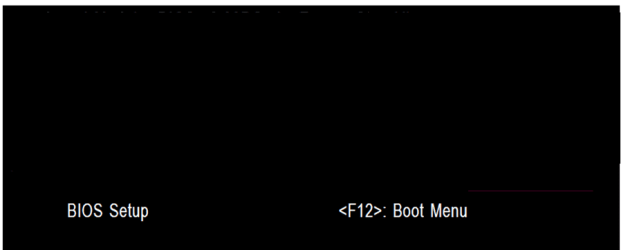
This a notebook PC that I only bought a couple of months ago, so how do I get into the BIOS to alter the boot settings ?
 

My Computer

OS
Windows home premium 64 bit
CPU
AMD Athlon II Dual Core 2.3Ghz
Memory
2048 MB DDR SD RAM
Graphics Card(s)
AMD M88OG with ATI Mobility Radeon HD 4250
Hard Drives
500 Gb
How to Boot your Computer from a Bootable CD or DVD

Enter BIOS setup as shown in tutorial above, set DVD drive to boot first, then HDD.

You should then get a prompt to "Press any Key' when you start with DVD in drive. If not, confirm the ISO and burn another DVD using ImgBurn at 4x speed, or write ISO to flash stick using this tool with Win7 in dropdown: Universal USB Installer – Easy as 1 2 3 | USB Pen Drive Linux

If no prompt to "Press any key" then try using the one-time BIOS Boot Menu key given on first boot screen.

Next check the mobo connections for data and power cables to OD, clean it and disk. Swap in another OD or try USB install method given.
 
I have a Compaq Presario CQ62-402AU with Windows 7 preinstalled.When I tried to follow this tutorial to have a dual boot system with XP I ran into a major problem streight away.The BIOS on this PC will not let me boot from CD ?
This a notebook PC that I only bought a couple of months ago, so how do I get into the BIOS to alter the boot settings ?

First check for all the Win XP drivers for your hardware.
You can check your HP/compaq PC here:
General XP Downgrade Guide for HP Laptops - HP Support Forum
NOTE: Please read this thread fully.


If your Win XP CD, does not support your Sata Controller, you will need to load drivers to uses at F6.
Load Sata Controller drivers with a floppy disk is the best way.
http://www.sevenforums.com/tutorials/66010-sata-drivers-load-windows-xp-setup-dual-boot.html
OR
http://www.sevenforums.com/tutorials/72185-sata-drivers-slipstream-into-windows-xp-cd.html


System Restore Points - Stop XP Dual Boot Delete - Vista Forums
 

My Computer

OS
ME/XP/Vista/Win7
Back
Top