SSD - Install and Transfer the Operating System

How to Physically Install a SSD and Transfer the Operating System


Introduction

If you never owned an SSD, you have missed something. Yes, they are not cheap, but Dollar per Dollar there is no other piece of hardware that can give you as much additional performance than an SSD.

Because SSDs are expensive, their current use is for placing the operating system. That’s how you get the best mileage. Although XP and Vista can be installed on SSDs, it is recommended to use them for Windows7, which is the first system to support Trim.

For desktops, an SSD with a 60GB capacity is usually sufficient. The user data can be moved to the HDD – I will explain the procedure later. Should you have very large programs, e.g., games, you should move their program files during the installation of the game to the HDD too.

For laptops, the situation is more complicated because you usually have only one disk bay. I use 80GB and 90GB SSDs on my laptops. In addition, I use the HDD that I recovered from the laptop after I installed the SSD in an external USB enclosure. But, if you move around a lot with the laptop, that may not be so convenient and a bigger SSD (120GB or 250GB) may be in order (budget allowing).


Hardware Installation

For a desktop, you will need a bracket if it is a 2.5” SSD (like most today). But, there are also 3.5” SSDs that will fit without adaptor brackets into the disk bays. You also need a cable to attach the SSD to the motherboard. For electricity, there is usually an extra plug at the PSU which you can use for the SSD’s.

Once you have all those bits, you can install the SSD in an available disk bay – or if none available, some self-adhesive Velcro will also do. The SSDs are light and do not produce any vibration or heat.

For a laptop, you need an external enclosure that attaches to a USB port. That will allow you to make the initial SSD setups. The one I linked attaches via USB2 and eSata, which may be practical later to use as external drive with the HDD that you recovered from the laptop. Also for hot swapping bare bone HDDs. But there are cheaper enclosures for USB2 only and also some that allow attachment to USB3.

Transfer the Operating System

There are two ways to transfer the operating system from your current HDD to the SSD:
1. The Geeky way which comes for free and
2. The easy way that costs $19.95.

1.The Geeky way requires the following steps:

Prepare the SSD – You first have to initialize the SSD to create the MBR. You can do that with Disk Management or with this program (which you will need later anyhow).

Then you need to align the SSD and define an active partition on it. You use an elevated Command Prompt with the following commands:

Diskpart
List disk
Select disk n (where n is the number that was given for your SSD in List disk)
Clean
Create partition primary align=1024
Format fs=ntfs quick
Active (assuming you want to install an OS)
Exit

Note: If you are more comfortable working with Disk Management, you can also define a primary active partition with Disk Management. On a SSD, the partition will be automatically aligned by 1024.


If you want to verify that the alignment is correct, you use these commands:

Diskpart
List disk
Select disk n
List partition


You should see a result like this:

Partition ### Type Size Offset


------------- ---------------- ------- -------
Partition 1 Primary 59 GB

1024 KB - but 64KB or any number divisible by 4 is also good. The offset has to be divisible by 4.

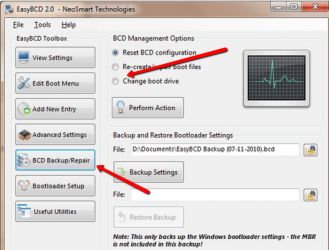
In Windows7, you may have the 100MB active boot partition. The easiest way to deal with that is to move the bootmgr to the C: partition using EasyBCD. That you do on your HDD before you transfer anything to the SSD. Then you do not have to worry about it and you need only transfer the C: partition to the SSD.


But if you care to keep the 100MB partition, then the partition you just created on the SSD is for that 100MB partition. The next step is to shrink the partition you just created to a 100MB size (make sure it is not any smaller). With Disk Management you will have trouble to do that. I recommend this program for the operation.

From the free space you gained, you create the C: partition for the OS. This partition must not be active and need not be a primary (because the 100MB partition contains the boot manager).

Alternatively and easier is if you first create the 100MB partition with these commands:

Diskpart
List disk
Select disk n (where n is the number that was given for your SSD in List disk)
Clean
Create partition primary size=100 align=1024
Format fs=ntfs quick
Active
Exit

Note: The unit in the size parameter is MB

After this action you can use Disk Management to create the C partition from the remaining unallocated space. That can be a logical partition.

If there is no 100MB partition, things are easy. The partition you created with Command Prompt will receive the C partition including boot manager and all.

There may be more partitions on your factory HDD – e.g., the Recovery partition and a Tools Partition. Those you should not transfer to the SSD because of space constraints. I would back them up – e.g., with an imaging program. The Recovery Partition you can also burn to DVDs.

The OS transfer

This is done with an image. There are a variety of free imaging programs (e.g., the free editions of Macrium, Paragon, Acronis, etc.) that are suitable for the task. You can also use the Windows7 imaging, which has the advantage that it deals with the 100MB active boot partition automatically. Disadvantage is that you never know exactly what it does.

You image your partitions to an external disk (you may have to assign a drive letter to the 100MB partition so that the imaging program can identify it) and then pull the images back in to the SSD (using the bootable recovery program of the imaging program).
The recovery is partition by partition. So you have to make separate runs for the 100MB partition (if any) and the C: partition.

Note: Many free imaging programs cannot shrink the originating partition to fit into the usually much smaller C: partition on the SSD - even if the amount of data in that partition would fit. In that case you will need to shrink the C: partition on the HDD prior to imaging it. The HDD C: partition must be smaller or equal in size to the designated partition on the SSD. For that operation I also recommend this program because Disk Management might not be able to shrink it enough. Note: Free Macrium can image to a smaller disk if the data fits.

It is, of course, understood, that the amount of data on your HDD C: partition must not exceed the capacity of the designated C: partition on the SSD. Should you have more data on your HDD C: partition than the size of the SSD C: partition can hold, I suggest you first create a data partition on the HDD system and move the user data there. Here is my video tutorial that explains how this is done. When you finally are on the SSD system, you then right click on the user folders in the data partition (Documents, Pictures, etc.) and Include them into the appropriate library. That approach does not require you to move the user folders later.

Next step is to change the boot sequence in the BIOS to set the SSD as second boot device (leave the CD/DVD reader as first boot device) and, hopefully, your system will boot.

2.The easy way for transferring the OS requires you to purchase this program. It does everything for you – alignment, deals with the 100MB partition, transfers C:, shrinks the originating partition, etc. All you will have to do is change the boot sequence.

Note: Before you activate the SSD, it is recommended to set the BIOS to AHCI. Best time to do that is just before you change the boot sequence. Once Windows7 is running, you make the corresponding settings in the OS. Here is a tutorial on how to do that.
Many people claim that there is a significant performance gain with AHCI. I, however, did not see that. But it may be different from system to system.

Settings after the OS transfer

Disk Defragmentation makes no sense on an SSD. For a laptop, go into Services, navigate to Disk Defragmenter, right click on it and go to Properties. Here you set the service to Disabled.
For a desktop, you may want to disable defrag in the Disk Defragmenter and only for the SSD so that the remaining HDDs can still be defragmented.

Note: As long as Defrag Service is turned off, you cannot shrink any partition. The partition shrink process requires the Defrag service. If you need to shrink a partition later, turn the Defragmentation Service temporarily on.

Hibernation File – most of us do not use Hibernation, but Sleep instead. But, the hiberfile takes precious space on your SSD – to the same tune as the size as your RAM. To get rid of it, run the following command in elevated Command Prompt: powercfg –h off. If you ever want it back, it is powercfg – h on.

Superfetch – many “experts” suggest to turn Superfetch off. I think that is not appropriate. Fetching a program or data from RAM is still a lot faster than fetching it from a disk – even from an SSD.

There are no other settings that are necessary. On the SSD forums you will find a lot of tweaks. I recommend you stay away from them.


Move the user folders to the HDD

To move the user folders to the HDD is very simple. Create a Data partition on the HDD. Define folders in that partition – e.g., Documents, Music, Pictures, etc. One for each folder you want to move off the SSD. The name of those folders can be anything. The system will rename them anyhow. It is just more obvious if you call them by the same name as the originating folders.

Then, open the Explorer and right click on, e.g., My Documents folder (not the Documents Library) in the left pane. Go to Properties and click on the Location tab. Here you click on Move and navigate to the corresponding folder in your Data Partition on the HDD. Then you Select that folder and Apply it.

Very Important: You must move the SSD folder to the corresponding Data Partition folder – NOT to the root of the partition itself. That would create a mess.


Last edited:
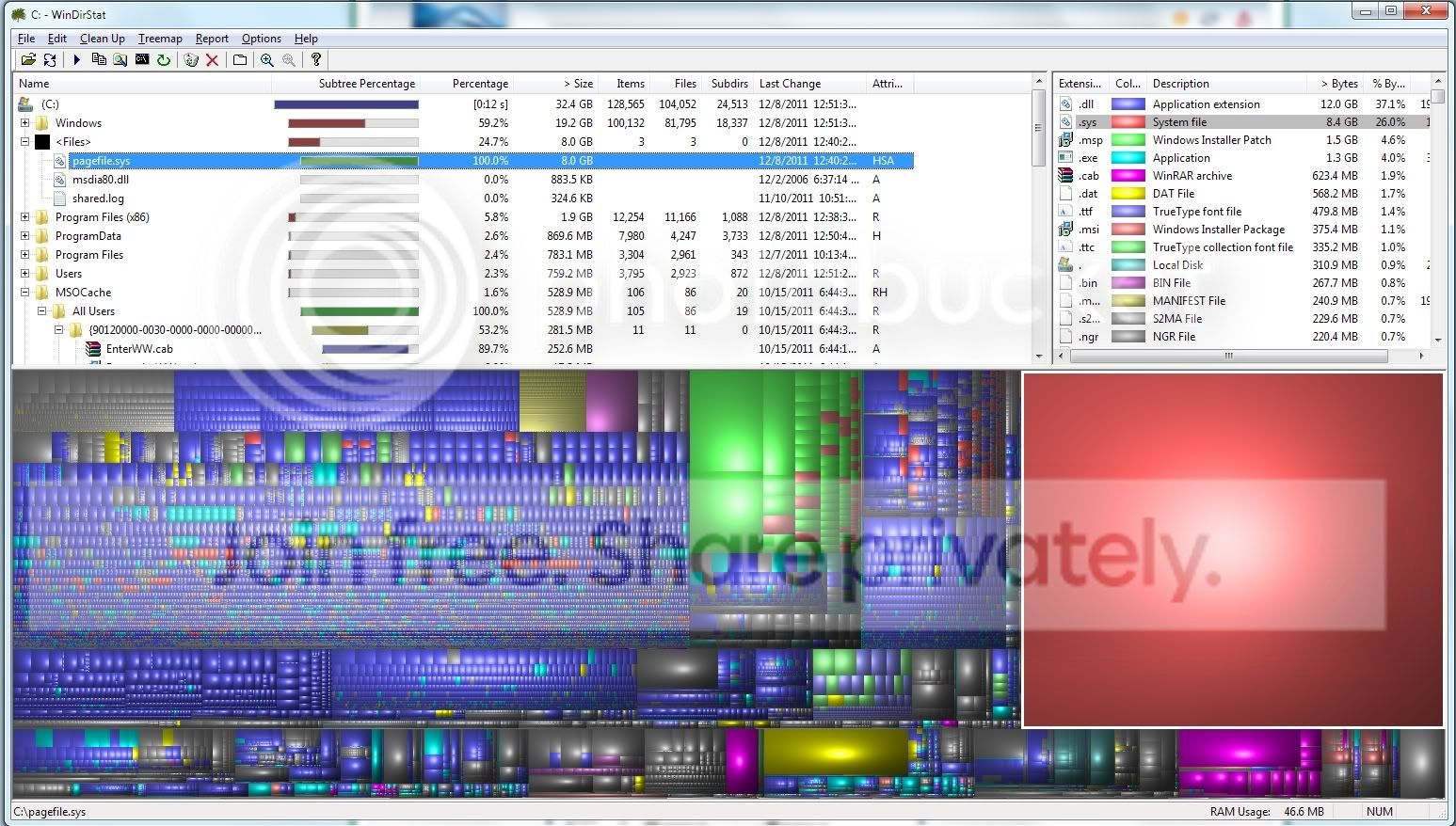
This is the result:
WinDirStat.jpg


Not really sure what I can remove. they all sound important :|
 

My Computer

OS
Windows 7 Professional x64
CPU
AMD Phenom II x4 955 BE 3.8GHz
Motherboard
Biostar A870u3
Memory
Corsair XMS3 8 GB (2 x 4GB) 1333 MHz
Graphics Card(s)
GTX 560 Ti
Monitor(s) Displays
23.6" Asus
Screen Resolution
1920X1080
Hard Drives
OCZ Vertex 3 90GB SSD,
WD Caviar Black 1 TB HDD
PSU
Antec EarthWatts EA650 650W
Case
Antec 300
Cooling
CM Hyper 212+
Keyboard
Das Keyboard
Mouse
Logitech G500
Internet Speed
Not fast enough
7.9 is as good as it gets. Must be really flying.
 

My Computer

Computer Manufacturer/Model Number
HP, Dell, Gateway, Toshiba - 4 laptops and 2 desktops
OS
Vista, Windows7, Mint Mate, Zorin, Windows 8
CPU
from 1.6GHz Duo to i7
Monitor(s) Displays
2x HP w2207
Hard Drives
5x HDD, 7x SSD, 12x Externals
Keyboard
with trackball - no mices
Mouse
Trackball mice
Internet Speed
DSL 6000

My Computer

OS
Windows 7 Professional x64
CPU
AMD Phenom II x4 955 BE 3.8GHz
Motherboard
Biostar A870u3
Memory
Corsair XMS3 8 GB (2 x 4GB) 1333 MHz
Graphics Card(s)
GTX 560 Ti
Monitor(s) Displays
23.6" Asus
Screen Resolution
1920X1080
Hard Drives
OCZ Vertex 3 90GB SSD,
WD Caviar Black 1 TB HDD
PSU
Antec EarthWatts EA650 650W
Case
Antec 300
Cooling
CM Hyper 212+
Keyboard
Das Keyboard
Mouse
Logitech G500
Internet Speed
Not fast enough
You could try it. Just be careful when you manipulate the registry. Better backup the registry first or image the whole system - which you should do from time to time anyhow.
 

My Computer

Computer Manufacturer/Model Number
HP, Dell, Gateway, Toshiba - 4 laptops and 2 desktops
OS
Vista, Windows7, Mint Mate, Zorin, Windows 8
CPU
from 1.6GHz Duo to i7
Monitor(s) Displays
2x HP w2207
Hard Drives
5x HDD, 7x SSD, 12x Externals
Keyboard
with trackball - no mices
Mouse
Trackball mice
Internet Speed
DSL 6000
Hey.

I've read everything up to now and am pretty confident I can do it the free way thanks to your very helpful posts.

My only real question at this time is what is the advantage of doing this over just doing a fresh install of the OS (on the SSD), after which installing/moving games/apps to the SSD, leaving the rest on the HDD?

Just wondering if I'm missing the reason for doing all this! :eek:

I'm thinking that it may be to do with not having to reinstall stuff, which may be quite important if you have lost discs etc.

I've just ordered my first SSD with the plan of putting the OS on it (performance gain) and some select games (Battlefield 3 for example - map loading, which takes ages, is meant to be far faster with an SSD).
 
Last edited:

My Computer

OS
Windows 7 Home Premium x64
My only real question at this time is what is the advantage of doing this over just doing a fresh install of the OS (on the SSD), after which installing/moving games/apps to the SSD, leaving the rest on the HDD?
The only real avantage is that you need not go thru a lengthy reinstallation. But if you do not mind to reinstall everything, that would be my preferred way too - if it only did not take 3 days to wrestle with all the updates, program installations, settings etc.
 

My Computer

Computer Manufacturer/Model Number
HP, Dell, Gateway, Toshiba - 4 laptops and 2 desktops
OS
Vista, Windows7, Mint Mate, Zorin, Windows 8
CPU
from 1.6GHz Duo to i7
Monitor(s) Displays
2x HP w2207
Hard Drives
5x HDD, 7x SSD, 12x Externals
Keyboard
with trackball - no mices
Mouse
Trackball mice
Internet Speed
DSL 6000
I figured that may be the case. I guess if you are fine with doing it this way (or using the program that does it all for you!) it is much quicker than reinstalling everything.

Actually I had another thought - if you bought a one-install windows 7 home premium would installing the OS onto the SSD as a fresh install invalidate it? It would be the "same" computer in the sense of every other component. I think I'll look this up unless you know how these work. It may be that copying the image over instead gets around this?

Edit: If I've researched it correctly the product key should still work if I only change my hard drive (in this case to a solid state drive). Cloning the image of the partition to the new drive should not invalidate the key either I think...
 
Last edited:

My Computer

OS
Windows 7 Home Premium x64
Correct, you can reinstall or image and the product key remains valid. Only if you were to reinstall or image to another system with an OEM key you would have a problem.
 

My Computer

Computer Manufacturer/Model Number
HP, Dell, Gateway, Toshiba - 4 laptops and 2 desktops
OS
Vista, Windows7, Mint Mate, Zorin, Windows 8
CPU
from 1.6GHz Duo to i7
Monitor(s) Displays
2x HP w2207
Hard Drives
5x HDD, 7x SSD, 12x Externals
Keyboard
with trackball - no mices
Mouse
Trackball mice
Internet Speed
DSL 6000
Using the newest version of macrium reflect and it seems this program is now able to clone the partitions directly for you, without needing to image etc.

Of course I'm new to it all so I may just be mistaking it somehow but maybe you want to take a look and see if this is the case. It seems that it may do it all for you like the paid version (but this is free!).

Macrium Reflect FREE Edition - Information and download
 

My Computer

OS
Windows 7 Home Premium x64
To make things easy and safe, you may want to consider using the Paragon Migration tool which is linked in the tutorial. Yes that would be an extra $19.95 but it does the job with 2 clicks and you do not have to worry about any of the traps mentioned in 1,2,3.

Hello WHS,

A great tutorial and the support you have provided to the forumers here would not have gone to waste had you been part of Paragon! (ie. I wish you worked for them)

I had bought Migrate OS to SSD on the suggestion of another website (and then from this thread) nearly two days ago, but it's given me nothing but grief and was a wholy unsuccessful venture. I've asked for a refund (my thread on their support forum has gone unanswered) and has left my computer performing sluggishly.

This is not a complaint post, but I would implore those reading this thread to read through some of the threads over at their support forum first, prior to purchase, for similarities of rig set-up, in case they are confronted with similar potential problems.
 

My Computer

OS
Windows 7 Home Premium x64
CPU
Intel i5-2500k
Motherboard
GA-P67A-UD4-B3
Memory
G.Skill Ripjaws X: F3 12800CL7D-8GBXH
Graphics Card(s)
GA GTX 560OC (1GB)
Sound Card
Asus Xonar Essence STX
Monitor(s) Displays
Sony Bravia
Screen Resolution
1920*1080
Hard Drives
Patriot Wildfire ATA (SSD ~ 128gb)
1TB HDD
PSU
Corsair HX650W
Case
Corsair 500r
Cooling
Coolermaster Hyper 212 Plus
Keyboard
Mionix Zibal 60
Mouse
SteelSeries Sensei
Other Info
Audioengine 5+ White (Speakers)

----------

Side machines: Sony PS3
Amiga 4000/40
Amiga 1260
Amiga 600

Server machine: i7-950, Antec DF-30, (more specs to follow as I remember them...)
To make things easy and safe, you may want to consider using the Paragon Migration tool which is linked in the tutorial. Yes that would be an extra $19.95 but it does the job with 2 clicks and you do not have to worry about any of the traps mentioned in 1,2,3.

Hello WHS,

A great tutorial and the support you have provided to the forumers here would not have gone to waste had you been part of Paragon! (ie. I wish you worked for them)

I had bought Migrate OS to SSD on the suggestion of another website (and then from this thread) nearly two days ago, but it's given me nothing but grief and was a wholy unsuccessful venture. I've asked for a refund (my thread on their support forum has gone unanswered) and has left my computer performing sluggishly.

This is not a complaint post, but I would implore those reading this thread to read through some of the threads over at their support forum first, prior to purchase, for similarities of rig set-up, in case they are confronted with similar potential problems.
I wonder what went wrong. I used the Paragon Migration tool 6 times now - 4 times on my own systems and twice on friend's systems. It worked flawlessly each time.

Can you describe the problems you encountered?
 

My Computer

Computer Manufacturer/Model Number
HP, Dell, Gateway, Toshiba - 4 laptops and 2 desktops
OS
Vista, Windows7, Mint Mate, Zorin, Windows 8
CPU
from 1.6GHz Duo to i7
Monitor(s) Displays
2x HP w2207
Hard Drives
5x HDD, 7x SSD, 12x Externals
Keyboard
with trackball - no mices
Mouse
Trackball mice
Internet Speed
DSL 6000
Hello whs,

I (and my brother) honestly thought it would all work out fine. I had wanted only Windows to go on the SSD, so I opted for the OCZ Agility 3 60gb. The only hurdle was we could not remember if we had installed AHCI on my Sandy Bridge, so we checked put the tutorial on this forum to enable it - but we saw in step three, that the parameter was set at '0' already (I can't seem to find the link to the tutorial at the moment, the OP has three words as his handle here). So there was no way that any AHCI drivers could be downloaded. So I purchased the software from Paragon.

Selected only the Windows folder and one or two more things (like locale and one or two more things). It calculated it all, said it was all fine and proceeded to do its thing. At just over 30% or thereabouts, it asked for a restart, which I duly did and then came up with an error (link to error will follow shortly).

Played about with BIOS to disable AHCI etc etc. But the same error would show up. Had my brother (more PC adept than I) go through your your tutorial and we went trawled through the net for similar problems. Nothing.

I ended up going through the related Paragon forums where someone who had the same problem as me had posted some three months ago. However, he was asked to do something which may not have helped his predicament at all. He got fed up, and he just demanded his money back and so the problem remained unresolved.

I also asked for help from there, but nothing was was forthcoming.

The related thread as follows (sorry, typing from a tablet, so my details here may remain a little scant):

Same error as previous member - Wilders Security Forums

I'm the only poster in that thread (Bodie_CI5), and my specs are given in the thread (more or less).

There I showed the two errors I came up against, but I'm still to receive any assistance.

There is no way I could've gotten as far as I did
 

My Computer

OS
Windows 7 Home Premium x64
CPU
Intel i5-2500k
Motherboard
GA-P67A-UD4-B3
Memory
G.Skill Ripjaws X: F3 12800CL7D-8GBXH
Graphics Card(s)
GA GTX 560OC (1GB)
Sound Card
Asus Xonar Essence STX
Monitor(s) Displays
Sony Bravia
Screen Resolution
1920*1080
Hard Drives
Patriot Wildfire ATA (SSD ~ 128gb)
1TB HDD
PSU
Corsair HX650W
Case
Corsair 500r
Cooling
Coolermaster Hyper 212 Plus
Keyboard
Mionix Zibal 60
Mouse
SteelSeries Sensei
Other Info
Audioengine 5+ White (Speakers)

----------

Side machines: Sony PS3
Amiga 4000/40
Amiga 1260
Amiga 600

Server machine: i7-950, Antec DF-30, (more specs to follow as I remember them...)
I suspect your problem stems from the fact that you let the PMT reduce the size of your data. I always make sure that my data fits on appr. 50% of the SSD.
Suggest you reduce the size of your data before you make the migration. I am pretty certain that this would work.

PS: AHCI should play no role in that. This is more of an SSD performance question.
 

My Computer

Computer Manufacturer/Model Number
HP, Dell, Gateway, Toshiba - 4 laptops and 2 desktops
OS
Vista, Windows7, Mint Mate, Zorin, Windows 8
CPU
from 1.6GHz Duo to i7
Monitor(s) Displays
2x HP w2207
Hard Drives
5x HDD, 7x SSD, 12x Externals
Keyboard
with trackball - no mices
Mouse
Trackball mice
Internet Speed
DSL 6000
I tried all differing combinations but the same errors occurred for some reason. I mean, the point is somewhat moot as I have since uninstalled the program (single use only), it was more so that people be prepared for some difficulty with the software, in terms of support.

I will be trying your manual installation instead, hopefully tonight.

You're a top asset though, that was the other I tried stating in my previous post. :)
 

My Computer

OS
Windows 7 Home Premium x64
CPU
Intel i5-2500k
Motherboard
GA-P67A-UD4-B3
Memory
G.Skill Ripjaws X: F3 12800CL7D-8GBXH
Graphics Card(s)
GA GTX 560OC (1GB)
Sound Card
Asus Xonar Essence STX
Monitor(s) Displays
Sony Bravia
Screen Resolution
1920*1080
Hard Drives
Patriot Wildfire ATA (SSD ~ 128gb)
1TB HDD
PSU
Corsair HX650W
Case
Corsair 500r
Cooling
Coolermaster Hyper 212 Plus
Keyboard
Mionix Zibal 60
Mouse
SteelSeries Sensei
Other Info
Audioengine 5+ White (Speakers)

----------

Side machines: Sony PS3
Amiga 4000/40
Amiga 1260
Amiga 600

Server machine: i7-950, Antec DF-30, (more specs to follow as I remember them...)
Looking for HDD>SSD Transfer Assistance

Following this thread I have been trying to copy my win7 installation onto my new SSD and have been having quite a bit of bad luck. Hopefully someone here is able and willing to help.

I did not start with the advice here, but stumbled on it partway through the process, which may be the source of my problems, but I'm really not sure. I have a laptop with a 750G HDD and a bay for a second hard drive. First I created 2 new partitions on the SSD using GParted, a 100MB system partition and a 110G main partition. I used Macrium Free to copy over the contents of the equivalent partitions from my HDD (the C: drive being about 90GB out of 270). The SSD drive would not boot and requested a windows recovery disk to fix things. I do not have one, so I read more and found this thread.

I tried to bring the SSD back to its factory state, though at this point I can't remember what utility I used to do that. I then followed the instructions in this thread

Diskpart
List disk
Select disk 1
Create partition primary size=100 align=1024
Create partition primary align=1024

and the suggested check routine looked as it was supposed to. I then used Macrium to first initialize the MBR and then to make individual images of the System and C: drives, saving the images on the D: partition of the HDD. I burned a Macrium boot recovery CD as prompted when I started the program. When I loaded up the restore program from the bootable CD it was unable to locate the SSD. The related file explorer could find the drives, but told me they were not formated NTFS. I went back into Windows7, opened Disk Management and formatted the 2 SSD partitions into NTFS, but when I went back to restore the images to it Macrium still didn't recognize the partitions.

I tried one final thing, just cloning the partitions directly in Windows7 as I had originally. This time the drive got farther in the booting process, not telling me that I needed a recovery disk, but it did stop at a blue screen and told me that my copy of Windows is not genuine (it is). Where do I go from here? I assume that I need to wipe the SSD again and start over. Is there a best way to do that? How can I get the bootable Macrium Recovery program to recognize the SSD and let me restore the images to them?

Thank you for any and all assistance.
 

My Computer

Computer Manufacturer/Model Number
Samsung rf711
OS
Win7 64 Home
CPU
i7 2630QM
Memory
8GB ram
Graphics Card(s)
nvidia 540m
I tried all differing combinations but the same errors occurred for some reason. I mean, the point is somewhat moot as I have since uninstalled the program (single use only), it was more so that people be prepared for some difficulty with the software, in terms of support.
I am a little confused with the license terms. You suggest it's a one shot deal?

WHS can you shed some light on the licensing constraints - I can't get a clear understanding from the Paragon Website.

Also, Drive Copy 11 Professional
Paragon Drive Copy - Professional Hard Disk Copy, Disk Cloning and System Migration - deploy new hard drive easily!
seems to do the same transfer plus other separate attractive capabilities

Anyone like to comment (yes it's $40 as opposed to $20)
 

My Computer

Computer type
PC/Desktop
Computer Manufacturer/Model Number
Own build
OS
Windows 7x64 Home Premium SP1
CPU
Intel i7 2600k
Motherboard
ASUS P8Z68 Deluxe
Memory
G.Skill Ripjaws (DDR3-1600) 2x4GB
Graphics Card(s)
Nvidia GeForce GTS 450; Intel HD Graphics 3000(GT2+)
Monitor(s) Displays
Dell Ultrasharp IPS panel U2311H, Samsung SyncMaster P2350
Screen Resolution
1920x1080
Hard Drives
Samsung 850 Pro SSD 256GB, Samsung SSD 840 120GB, Seagates 1TB Barracuda ST31000528AS x2
PSU
Seasonic M12II 520W
Case
Lian Li Lancool PC-K60
Cooling
Case: 1x120mm, 3x140mm CPU: Hyper 212+
Keyboard
Logitech MK520 (wireless)
Mouse
Logitech MK520
Internet Speed
6-7 Mbps
Antivirus
Norton Security Premium, Malwarebytes on 2 (MSE on 3rd PC)
Browser
FireFox
Other Info
Audio: Logitech Z523 2.1
does this tutorial apply to laptops or just desktops?
It applies to both. Except with laptops you need an external enclosure to setup the SSD - unless you have one of those rare 17" laptops with 2 disk bays.
 

My Computer

Computer Manufacturer/Model Number
HP, Dell, Gateway, Toshiba - 4 laptops and 2 desktops
OS
Vista, Windows7, Mint Mate, Zorin, Windows 8
CPU
from 1.6GHz Duo to i7
Monitor(s) Displays
2x HP w2207
Hard Drives
5x HDD, 7x SSD, 12x Externals
Keyboard
with trackball - no mices
Mouse
Trackball mice
Internet Speed
DSL 6000
Following this thread I have been trying to copy my win7 installation onto my new SSD and have been having quite a bit of bad luck. Hopefully someone here is able and willing to help.

I did not start with the advice here, but stumbled on it partway through the process, which may be the source of my problems, but I'm really not sure. I have a laptop with a 750G HDD and a bay for a second hard drive. First I created 2 new partitions on the SSD using GParted, a 100MB system partition and a 110G main partition. I used Macrium Free to copy over the contents of the equivalent partitions from my HDD (the C: drive being about 90GB out of 270). The SSD drive would not boot and requested a windows recovery disk to fix things. I do not have one, so I read more and found this thread.

I tried to bring the SSD back to its factory state, though at this point I can't remember what utility I used to do that. I then followed the instructions in this thread

Diskpart
List disk
Select disk 1
Create partition primary size=100 align=1024
Create partition primary align=1024 - I think that screwed it up

and the suggested check routine looked as it was supposed to. I then used Macrium to first initialize the MBR and then to make individual images of the System and C: drives, saving the images on the D: partition of the HDD. I burned a Macrium boot recovery CD as prompted when I started the program. When I loaded up the restore program from the bootable CD it was unable to locate the SSD. The related file explorer could find the drives, but told me they were not formated NTFS. I went back into Windows7, opened Disk Management and formatted the 2 SSD partitions into NTFS, but when I went back to restore the images to it Macrium still didn't recognize the partitions.

I tried one final thing, just cloning the partitions directly in Windows7 as I had originally. This time the drive got farther in the booting process, not telling me that I needed a recovery disk, but it did stop at a blue screen and told me that my copy of Windows is not genuine (it is). Where do I go from here? I assume that I need to wipe the SSD again and start over. Is there a best way to do that? How can I get the bootable Macrium Recovery program to recognize the SSD and let me restore the images to them?

Thank you for any and all assistance.

1. see my comment in red in the quote

2. I think you are dying on the difficulties with the 100MB partition. I suggest you use EasyBCD to transfer the bootmgr from the 100MB partition to C (see picture). Do that on the HDD before you start the imaging of your C partition on the HDD with Macrium.

3. Then you run those commands on the SSD, but no size parameter

Diskpart
List disk
Select disk n (where n is the number that was given for your SSD in List disk)
Clean
Create partition primary align=1024
Active
Exit

This will create on big partition over your whole SSD into which you can restore the image that you took after you moved the MBR. Important: Prerequisite is that the partition on the HDD from where you imaged was no bigger than the partition on the SSD. If you then still cannot boot, you might have to fix the MBR with the bootable CD of Partition Wizard. With all the operations you did on the SSD, no way of knowing in what shape the MBR is.
 

Attachments

  • 2012-01-16_1334.png
    2012-01-16_1334.png
    561.6 KB · Views: 500

My Computer

Computer Manufacturer/Model Number
HP, Dell, Gateway, Toshiba - 4 laptops and 2 desktops
OS
Vista, Windows7, Mint Mate, Zorin, Windows 8
CPU
from 1.6GHz Duo to i7
Monitor(s) Displays
2x HP w2207
Hard Drives
5x HDD, 7x SSD, 12x Externals
Keyboard
with trackball - no mices
Mouse
Trackball mice
Internet Speed
DSL 6000
I tried all differing combinations but the same errors occurred for some reason. I mean, the point is somewhat moot as I have since uninstalled the program (single use only), it was more so that people be prepared for some difficulty with the software, in terms of support.
I am a little confused with the license terms. You suggest it's a one shot deal?

WHS can you shed some light on the licensing constraints - I can't get a clear understanding from the Paragon Website.

Also, Drive Copy 11 Professional
Paragon Drive Copy - Professional Hard Disk Copy, Disk Cloning and System Migration - deploy new hard drive easily!
seems to do the same transfer plus other separate attractive capabilities

Anyone like to comment (yes it's $40 as opposed to $20)

I have used the program several times on different systems (and in different countries - lol) and it has always worked. I interpret "single license" as allowed for the same person. That may be a bit stretched, but it works.
 

My Computer

Computer Manufacturer/Model Number
HP, Dell, Gateway, Toshiba - 4 laptops and 2 desktops
OS
Vista, Windows7, Mint Mate, Zorin, Windows 8
CPU
from 1.6GHz Duo to i7
Monitor(s) Displays
2x HP w2207
Hard Drives
5x HDD, 7x SSD, 12x Externals
Keyboard
with trackball - no mices
Mouse
Trackball mice
Internet Speed
DSL 6000
Back
Top