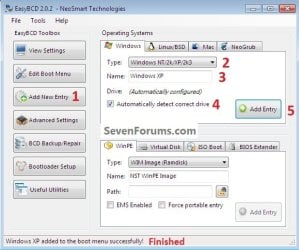
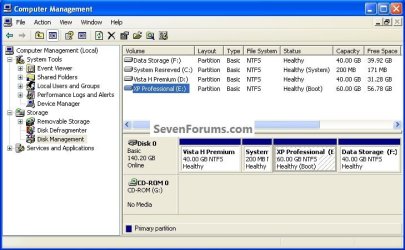
System Reserved : Create Using Disk Management

Create the New Windows 7 System Reserved Partition Using Windows Disk Management

This information can be used to create the Windows 7 System Reserved partition after you have installed Windows using only Windows native disk management.

The main advantage of the System Reserved partition, it adds a link to WinRE (Windows Recovery Environment) to the F8 advanced boot options in Windows 7 that can be accessed during PC startup to repair startup errors if a Windows installer or a system repair disk isn't available for use; it also creates a central location to store the boot files needed to start Windows in a dual/multi boot situation and that makes it very easy to replace/remove a single OS when needed.

There must be at least one (1) Primary partition for creation/use as the System Reserved partition will not function as intended from an Extended partition; for further information on this requirement see Option Two #2 below.
   Warning

As with anything that makes changes to the Windows structure there is always the chance for an error to occur, it would be advisable to make reliable backups to the media of your choice of any important data, i.e. pictures, music or documents, that you would not want to lose before you attempt any of the methods out-lined here, it is always better to be safe than sorry.

Let's get started!

Have a look at this tutorial before you start this for an alternative method.

System Reserved : Create for Dual Boot


Option One

Create the Windows 7 Syetem Reserved Partition


In the Windows start menu search box type diskmgmt.msc right click the entry and click "Run as Administrator" if you get a User Account Control (UAC) prompt enter your user credentials and click Yes.

1) In the disk management window and assuming you have created or already have unallocated space to start with, right click that space and click New Simple Volume then Next for the first "Wizard" dialog box.
click any image to enlarge
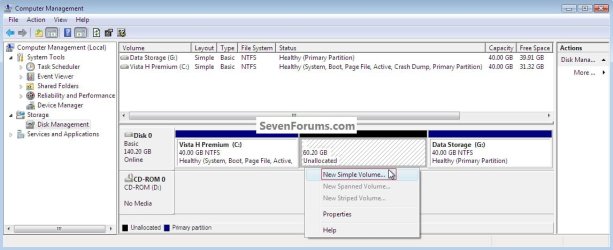
NewSimpleVolume.jpg
2) In the "Specify Volume Size" box type 200 for the size to create and click Next.

The reason for suggesting to create the System Reserved at 200MB instead of the new default of 100MB is an attempt to curb some of the issues we're now seeing with the partition being too small when dual/multi booting and it also being needed for use with the Windows 7 Backup and Restore and BitLocker programs.
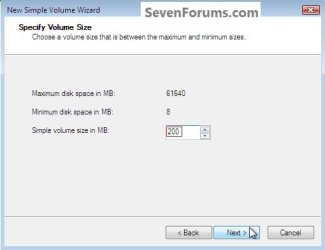
Size.jpg
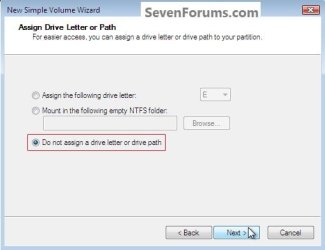
3) In the "Assign Drive Letter" box do not assign a drive letter and click Next.
Assign.jpg
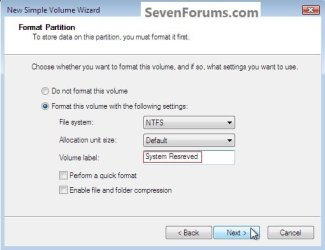
4) In the "Format" box at the "Volume Label" line type System Reserved and do not put a check/tic at the "quick" box and click Next
Label.jpg
5) At the last "Completing" wizard dialog box click Finish to complete the process.


Option Two

Install a second Windows Operating System


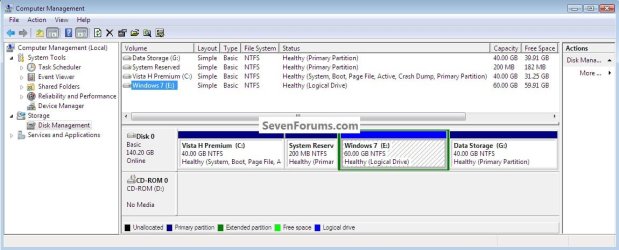
1) Now if you want to install a second Windows OS using the remaining unallocated space it's a very easy process; create this partition in the same way you created the SysResv partition; when you get to the "Specify Volume Size" dialog box click Next to accept the offered size or you can choose to create a specific size; for this one you can assign the next available drive letter; then at the "Format" box you would use a Label (name) that you choose like Windows 7 or whatever you like and click Finish for the last "Wizard" dialog box.
click any image to enlarge
W_7Logical.jpg
2) If there are already three (3) existing Primary partitions Windows will only create the fourth partition as an Extended partition, if you end up with an Extended/Logical drive, you can choose to do the Windows installation to the Logical drive and there will be no issues at all if you do and it can always be converted to a Primary partition at a later time if you choose.

For further information on the creation and use of Extended partition / Logical drives, have a look at this tutorial and its related links listed below.

System Reserved : Multi Boot from Logical Partitions

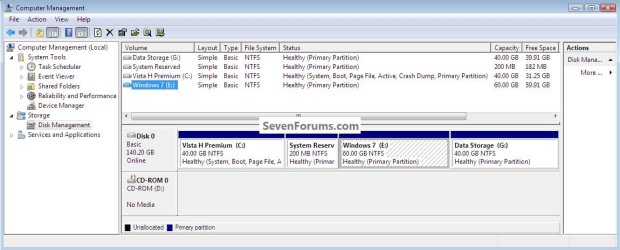
3) Strictly for demonstration purposes here, I'm going to use the free Partition Wizard bootable disk (PWBD) to convert the Extended to a Primary partition before the Windows installation so that I will have four (4) Primary partitions, for an out-line of the process see Option Four in this tutorial.

Partition Wizard : Use the Bootable CD
W_7Primary.jpg
SetPrimary.jpg
Method One: Install Windows 7 / Vista

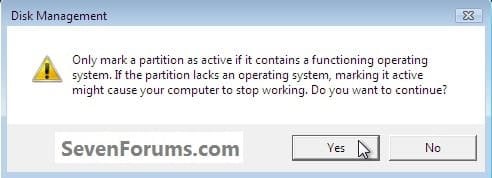
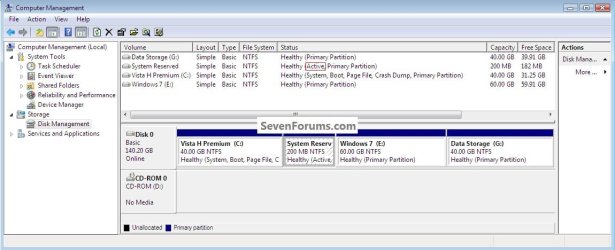
1) The first thing is to mark the "System Reserved" partition as "Active" so Windows will know where to create the system volume, where the system boot files are stored; in Windows disk management right click the SysResv partition and click "Mark as Active" then Yes for the conformation dialog box, the third snip is what you will have.
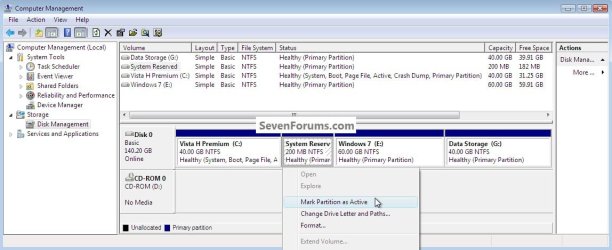
SRW_7MarkActive.jpg
ActiveYes.jpg
SRActive2.jpg
2) Now insert the Windows install media into the Optical Disk Drive and restart the PC to set the first boot device as the ODD in the BIOS and install Windows 7 to the created "Windows 7" partition.

You will want to do a clean install choosing the "Custom (advanced)" not the "Upgrade" option, when you are presented with this "Where do you want ... " dialog box click to choose the created "Windows 7" partition and click next; do not use the installer to format anything.
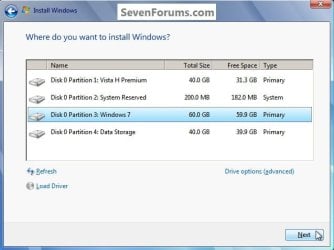
W_7Choose.jpg
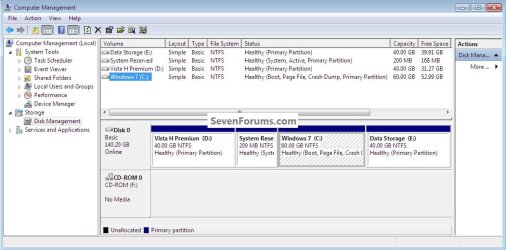
3) Here's the end result.
BootW_7.jpg
4) You will have to use EasyBCD from within Windows 7 to add an entry for Vista to the Windows boot (dual boot) menu but that's the easiest part of this process.
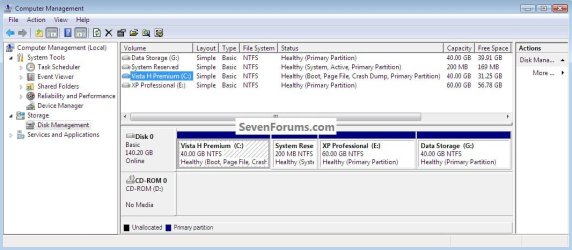
BootVista.jpg
Vista.jpg
Method Two: Install Windows XP

The XP partition has to remain the system volume for the installation process or it will cause all sorts of issues that have to be corrected before XP will boot correctly in conjunction with the use of the "System Reserved" partition in a dual/multi boot configuration; this method is only possible using a Primary partition, it is not possible using an Extended/Logical drive.

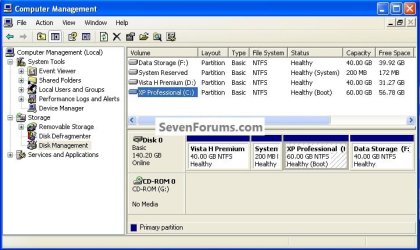
1) Use the same methods above to create both the SysResv and a partition to install XP to; right click the created XP partition and click "Mark as Active" then Yes for the conformation dialog box.
click any image to enlarge
XPMarkActive.jpg
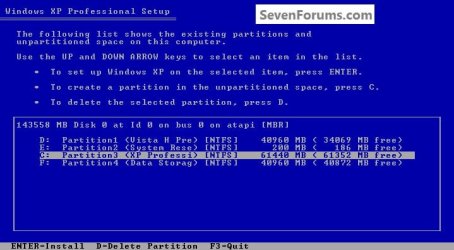
2) Now insert the Windows install media into the Optical Disk Drive and restart the PC to set the first boot device as the ODD in the BIOS and install Windows XP to the created "XP Professional" partition; do not use the installer to format anything.
XPChoose.jpg
When XP starts, these next steps have to be done and done in this order to get XP and whichever OS (Vista / Windows7) you're dual booting to boot correctly so you won't have issues later.

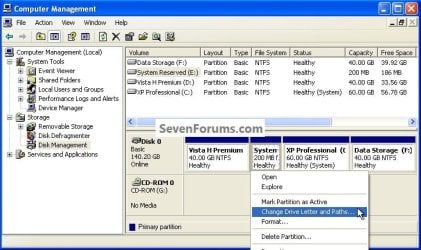
3) In Windows XP disk management, right click the "System Reserved" partition and click "Change Drive Letter" then in the dialog box that opens click "Remove" then Yes for the "Confirm" dialog box.
XPRemoveLetter.jpg
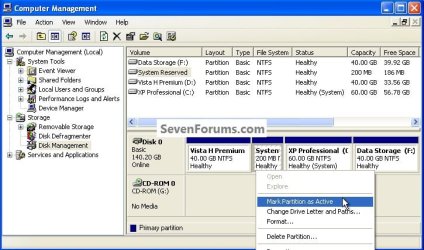
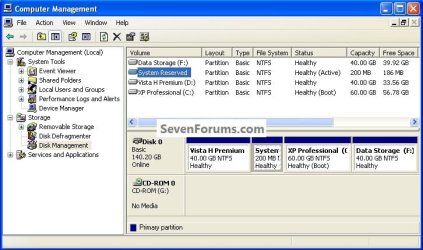
4) Now right click the SysResv partition and click "Mark as Active" then Yes for the "Disk Management" conformation dialog box; the second snip is what you should have.
SysResvMarkActive.jpg
SysResvActive.jpg
5) Now put a Windows 7 / Vista full installer DVD or a created repair disk into the Optical Disk Drive (ODD) and restart the PC, at the BIOS select the ODD as the first boot device and run the 3 separate startup repairs with a system restart between each repair to create the boot files needed to start the dual boot to the "System Reserved" partition; information on the entire process can be viewed at these tutorials below.

Startup Repair - Run 3 Separate Times

How to Run a Startup Repair in Windows 7
BootVista.jpg
6) One last step; you will have to use EasyBCD from within Vista / Windows 7 to add an entry for XP to the Windows boot (dual boot) menu to get back to XP but that's the easiest part of this process.
BootXP.jpg
XPAdd.jpg
Enjoy :)


Attachments

  • XPBoot.jpg
    XPBoot.jpg
    196.5 KB · Views: 30
Last edited by a moderator:
Hello maiki.


After the System Reserved is created, you would need to mark that the Active partition and run the 3 separate startup repairs to the new SysResv partition, to (re)create the "System" system volume boot files it that location; then that will place the "Repair my Computer" link on the advanced boot options boot menu.


There is additional information contained in this tutorial at the link below and be sure to post back with any further questions you may have and to keep us informed.

Startup Repair - Run 3 Separate Times
 

My Computer

Computer Manufacturer/Model Number
* BFK Customs *
OS
W 7 64-bit Ultimate
CPU
Intel Q9550 Yorkfield
Motherboard
ASUS P5Q Pro
Memory
8GB Dominator 8500C5D
Graphics Card(s)
ATI : XFX 5870
Sound Card
Realtek HD Audio 7-1
Monitor(s) Displays
1x 47" LCD HDMI & 3x 26" LCD HDMI
Screen Resolution
1920x1080P & 1920x1200
Hard Drives
1x 80GB Intel X25-M G2 SSD : 1x 500GB & 1x 640GB WD Caviar Black(s)
PSU
Corsair 620HX
Case
Cooler Master RC-690
Cooling
Tuniq Tower 120, 2x 140mm and 3x 120mm case fans
Keyboard
Microsoft 500
Mouse
Razer Diamondback 3G
Internet Speed
14 Mb/s
Other Info
1x Koutech 3Gb/s SATA HDD Hot Swap Rack
Thanks for the explanation.

My situation-I have dual-boot XP and 7 set up. It used to work-- startup repair, without optical disc.

However later, after the Win7 install became corrupted, and I had to do a repair install, it doesn't work. I still see the option under the advanced F8 boot options, but if I choose it, it tells me to insert my Win7 disc and reboot.

I have the Win7 DVD, and can do startup repair from there. However, the computer in question is a netbook, without built-in CD-DVD drive. If I am anywhere besides home, I don't have the USB optical drive, and disc with me. So I would like to get that capability back.

Now, if I just mark the newly created System Reserved partition as Active, and reboot, it won't boot, correct, as there is no OS there?

I don't know what you mean by:

run the 3 separate startup repairs to the new SysResv partition


Could you please explain? I can run startup repair (from the DVD) but how do I run it to the system reserved partition?

Thank you.

Hello maiki.


After the System Reserved is created, you would need to mark that the Active partition and run the 3 separate startup repairs to the new SysResv partition, to (re)create the "System" system volume boot files it that location; then that will place the "Repair my Computer" link on the advanced boot options boot menu.


There is additional information contained in this tutorial at the link below and be sure to post back with any further questions you may have and to keep us informed.

Startup Repair - Run 3 Separate Times
 

My Computer

OS
Windows 7
You need to mark the SysResv as the Active partition and run the 3 separate startup repairs to create the SysResv partition as the "System" partition, where the boot files are stored.


Please post a snip on the maximized Windows disk management so I can see it.

In the Windows start menu right click computer and click manage, in the left pane of the "Computer Management" window that opens click disk management and post a maximized snip of that.

How to Upload and Post a Screenshot and File in Seven Forums
 

My Computer

Computer Manufacturer/Model Number
* BFK Customs *
OS
W 7 64-bit Ultimate
CPU
Intel Q9550 Yorkfield
Motherboard
ASUS P5Q Pro
Memory
8GB Dominator 8500C5D
Graphics Card(s)
ATI : XFX 5870
Sound Card
Realtek HD Audio 7-1
Monitor(s) Displays
1x 47" LCD HDMI & 3x 26" LCD HDMI
Screen Resolution
1920x1080P & 1920x1200
Hard Drives
1x 80GB Intel X25-M G2 SSD : 1x 500GB & 1x 640GB WD Caviar Black(s)
PSU
Corsair 620HX
Case
Cooler Master RC-690
Cooling
Tuniq Tower 120, 2x 140mm and 3x 120mm case fans
Keyboard
Microsoft 500
Mouse
Razer Diamondback 3G
Internet Speed
14 Mb/s
Other Info
1x Koutech 3Gb/s SATA HDD Hot Swap Rack
Excellent tutorial.
I have a doubt though, after the system reserved partition is created, will windows move the boot files or whatever is supposed to be on that partition all by itself after this partition is created and add the F8 winre option without giving it any additional commands to do so?

EDIT: also will it be fine to create just the 100mb partition cause i never intend to dual boot.
 

My Computer

OS
Windows 7 Ultimate x86
CPU
Intel e5300 @2.6
Motherboard
MSI g31tm-p21
Memory
Kingston 2x1+1x1 DDR2 800mhz
Graphics Card(s)
Sapphire radeon 5670 1GB
Hard Drives
WD 320GB
PSU
FSP Saga II 400watts
Hello mate, thanks!


You can create it a 100MB if you like; after it's created you will have to mark it Active and run the 3 separate startup repairs with restarts, to (re)create the "System" boot files to the new SysResv, have a look at this tutorial at the link below and be sure to post back with any further questions you may have and to keep me informed.

Startup Repair - Run 3 Separate Times


My Computer

Computer Manufacturer/Model Number
* BFK Customs *
OS
W 7 64-bit Ultimate
CPU
Intel Q9550 Yorkfield
Motherboard
ASUS P5Q Pro
Memory
8GB Dominator 8500C5D
Graphics Card(s)
ATI : XFX 5870
Sound Card
Realtek HD Audio 7-1
Monitor(s) Displays
1x 47" LCD HDMI & 3x 26" LCD HDMI
Screen Resolution
1920x1080P & 1920x1200
Hard Drives
1x 80GB Intel X25-M G2 SSD : 1x 500GB & 1x 640GB WD Caviar Black(s)
PSU
Corsair 620HX
Case
Cooler Master RC-690
Cooling
Tuniq Tower 120, 2x 140mm and 3x 120mm case fans
Keyboard
Microsoft 500
Mouse
Razer Diamondback 3G
Internet Speed
14 Mb/s
Other Info
1x Koutech 3Gb/s SATA HDD Hot Swap Rack
Alright thanks BareFootKid that certainly clarified things.

However i guess i won't be able to easily extend my c: after this partition has been created to its right, i'll be doing this after getting another hdd and extending c to the max win7 should ever need as presently its just 40gb and quickly running out.
 

My Computer

OS
Windows 7 Ultimate x86
CPU
Intel e5300 @2.6
Motherboard
MSI g31tm-p21
Memory
Kingston 2x1+1x1 DDR2 800mhz
Graphics Card(s)
Sapphire radeon 5670 1GB
Hard Drives
WD 320GB
PSU
FSP Saga II 400watts
Alright thanks BareFootKid that certainly clarified things.

However i guess i won't be able to easily extend my c: after this partition has been created to its right, i'll be doing this after getting another hdd and extending c to the max win7 should ever need as presently its just 40gb and quickly running out.


If you can post a snip of Windows disk management and clarify what you are referring to I may be more help to you; have a look at the info below.

   Note

In the Windows start menu right click computer and click manage, in the left pane of the "Computer Management" window that opens click disk management and post a maximized snip of that.

How to Upload and Post a Screenshot and File in Seven Forums


My Computer

Computer Manufacturer/Model Number
* BFK Customs *
OS
W 7 64-bit Ultimate
CPU
Intel Q9550 Yorkfield
Motherboard
ASUS P5Q Pro
Memory
8GB Dominator 8500C5D
Graphics Card(s)
ATI : XFX 5870
Sound Card
Realtek HD Audio 7-1
Monitor(s) Displays
1x 47" LCD HDMI & 3x 26" LCD HDMI
Screen Resolution
1920x1080P & 1920x1200
Hard Drives
1x 80GB Intel X25-M G2 SSD : 1x 500GB & 1x 640GB WD Caviar Black(s)
PSU
Corsair 620HX
Case
Cooler Master RC-690
Cooling
Tuniq Tower 120, 2x 140mm and 3x 120mm case fans
Keyboard
Microsoft 500
Mouse
Razer Diamondback 3G
Internet Speed
14 Mb/s
Other Info
1x Koutech 3Gb/s SATA HDD Hot Swap Rack
What i'm sayin is that presently i dont have a lot of free space on my hdd, and even lesser on the system partition c:, so i'll first have to get an additional hdd, move my data to that one, then carry out these and other partition modifications. :)
furthermore since the system reserved partition will be generated to the right side of c drive, i guess i wont be easily able to extend c drive in future, not with native disk management anyways. so i will first extend my c: to like a 100 gb then create the system reserved, which can only happen after i get another hdd.
 

My Computer

OS
Windows 7 Ultimate x86
CPU
Intel e5300 @2.6
Motherboard
MSI g31tm-p21
Memory
Kingston 2x1+1x1 DDR2 800mhz
Graphics Card(s)
Sapphire radeon 5670 1GB
Hard Drives
WD 320GB
PSU
FSP Saga II 400watts

My Computer

Computer Manufacturer/Model Number
* BFK Customs *
OS
W 7 64-bit Ultimate
CPU
Intel Q9550 Yorkfield
Motherboard
ASUS P5Q Pro
Memory
8GB Dominator 8500C5D
Graphics Card(s)
ATI : XFX 5870
Sound Card
Realtek HD Audio 7-1
Monitor(s) Displays
1x 47" LCD HDMI & 3x 26" LCD HDMI
Screen Resolution
1920x1080P & 1920x1200
Hard Drives
1x 80GB Intel X25-M G2 SSD : 1x 500GB & 1x 640GB WD Caviar Black(s)
PSU
Corsair 620HX
Case
Cooler Master RC-690
Cooling
Tuniq Tower 120, 2x 140mm and 3x 120mm case fans
Keyboard
Microsoft 500
Mouse
Razer Diamondback 3G
Internet Speed
14 Mb/s
Other Info
1x Koutech 3Gb/s SATA HDD Hot Swap Rack

My Computer

OS
Windows 7 Ultimate x86
CPU
Intel e5300 @2.6
Motherboard
MSI g31tm-p21
Memory
Kingston 2x1+1x1 DDR2 800mhz
Graphics Card(s)
Sapphire radeon 5670 1GB
Hard Drives
WD 320GB
PSU
FSP Saga II 400watts
EDIT: Furthermore is it necessary to use their bootable disk or can i just use the installer?

It would be very wise to use the boot disk, it's a lot more reliable than the installed version.


Here you go, thanks for the heads-up about the link, I have fixed that.

First download the Partition Wizard Bootable Disk (PWBD) ISO file to the desktop, be sure to get the PWBD and not the installed version; scroll down to see the download link for the bootable CD ISO file at this link below.
Partition Wizard Free Bootable CD
Then use ImgBurn to burn the ISO to a CD, at no greater than 4x speed with a verify; it was designed for use and works best from a CD rather that a then boot the created CD to make the changes.
ImgBurn Free ISO Burning Software


My Computer

Computer Manufacturer/Model Number
* BFK Customs *
OS
W 7 64-bit Ultimate
CPU
Intel Q9550 Yorkfield
Motherboard
ASUS P5Q Pro
Memory
8GB Dominator 8500C5D
Graphics Card(s)
ATI : XFX 5870
Sound Card
Realtek HD Audio 7-1
Monitor(s) Displays
1x 47" LCD HDMI & 3x 26" LCD HDMI
Screen Resolution
1920x1080P & 1920x1200
Hard Drives
1x 80GB Intel X25-M G2 SSD : 1x 500GB & 1x 640GB WD Caviar Black(s)
PSU
Corsair 620HX
Case
Cooler Master RC-690
Cooling
Tuniq Tower 120, 2x 140mm and 3x 120mm case fans
Keyboard
Microsoft 500
Mouse
Razer Diamondback 3G
Internet Speed
14 Mb/s
Other Info
1x Koutech 3Gb/s SATA HDD Hot Swap Rack
Ok will do! Burning it now. Hopefully everything goes according to plan. I'm taking a c drive image just in case.
 

My Computer

OS
Windows 7 Ultimate x86
CPU
Intel e5300 @2.6
Motherboard
MSI g31tm-p21
Memory
Kingston 2x1+1x1 DDR2 800mhz
Graphics Card(s)
Sapphire radeon 5670 1GB
Hard Drives
WD 320GB
PSU
FSP Saga II 400watts

My Computer

Computer Manufacturer/Model Number
* BFK Customs *
OS
W 7 64-bit Ultimate
CPU
Intel Q9550 Yorkfield
Motherboard
ASUS P5Q Pro
Memory
8GB Dominator 8500C5D
Graphics Card(s)
ATI : XFX 5870
Sound Card
Realtek HD Audio 7-1
Monitor(s) Displays
1x 47" LCD HDMI & 3x 26" LCD HDMI
Screen Resolution
1920x1080P & 1920x1200
Hard Drives
1x 80GB Intel X25-M G2 SSD : 1x 500GB & 1x 640GB WD Caviar Black(s)
PSU
Corsair 620HX
Case
Cooler Master RC-690
Cooling
Tuniq Tower 120, 2x 140mm and 3x 120mm case fans
Keyboard
Microsoft 500
Mouse
Razer Diamondback 3G
Internet Speed
14 Mb/s
Other Info
1x Koutech 3Gb/s SATA HDD Hot Swap Rack
No using win 7's builtin backup's system drive image.
 

My Computer

OS
Windows 7 Ultimate x86
CPU
Intel e5300 @2.6
Motherboard
MSI g31tm-p21
Memory
Kingston 2x1+1x1 DDR2 800mhz
Graphics Card(s)
Sapphire radeon 5670 1GB
Hard Drives
WD 320GB
PSU
FSP Saga II 400watts
The iso downloaded is at 37.5mb while the website states 39 mb.. whats up with that??
 

My Computer

OS
Windows 7 Ultimate x86
CPU
Intel e5300 @2.6
Motherboard
MSI g31tm-p21
Memory
Kingston 2x1+1x1 DDR2 800mhz
Graphics Card(s)
Sapphire radeon 5670 1GB
Hard Drives
WD 320GB
PSU
FSP Saga II 400watts

My Computer

Computer Manufacturer/Model Number
* BFK Customs *
OS
W 7 64-bit Ultimate
CPU
Intel Q9550 Yorkfield
Motherboard
ASUS P5Q Pro
Memory
8GB Dominator 8500C5D
Graphics Card(s)
ATI : XFX 5870
Sound Card
Realtek HD Audio 7-1
Monitor(s) Displays
1x 47" LCD HDMI & 3x 26" LCD HDMI
Screen Resolution
1920x1080P & 1920x1200
Hard Drives
1x 80GB Intel X25-M G2 SSD : 1x 500GB & 1x 640GB WD Caviar Black(s)
PSU
Corsair 620HX
Case
Cooler Master RC-690
Cooling
Tuniq Tower 120, 2x 140mm and 3x 120mm case fans
Keyboard
Microsoft 500
Mouse
Razer Diamondback 3G
Internet Speed
14 Mb/s
Other Info
1x Koutech 3Gb/s SATA HDD Hot Swap Rack
Presently its still just backing up... will have to restore sometime to find out lol
 

My Computer

OS
Windows 7 Ultimate x86
CPU
Intel e5300 @2.6
Motherboard
MSI g31tm-p21
Memory
Kingston 2x1+1x1 DDR2 800mhz
Graphics Card(s)
Sapphire radeon 5670 1GB
Hard Drives
WD 320GB
PSU
FSP Saga II 400watts
Some have serious issues with the default Windows 7 imaging program.
 

My Computer

Computer Manufacturer/Model Number
* BFK Customs *
OS
W 7 64-bit Ultimate
CPU
Intel Q9550 Yorkfield
Motherboard
ASUS P5Q Pro
Memory
8GB Dominator 8500C5D
Graphics Card(s)
ATI : XFX 5870
Sound Card
Realtek HD Audio 7-1
Monitor(s) Displays
1x 47" LCD HDMI & 3x 26" LCD HDMI
Screen Resolution
1920x1080P & 1920x1200
Hard Drives
1x 80GB Intel X25-M G2 SSD : 1x 500GB & 1x 640GB WD Caviar Black(s)
PSU
Corsair 620HX
Case
Cooler Master RC-690
Cooling
Tuniq Tower 120, 2x 140mm and 3x 120mm case fans
Keyboard
Microsoft 500
Mouse
Razer Diamondback 3G
Internet Speed
14 Mb/s
Other Info
1x Koutech 3Gb/s SATA HDD Hot Swap Rack
Only time will tell lol.. well it burnt n all and backed up. M goin in ;)
 

My Computer

OS
Windows 7 Ultimate x86
CPU
Intel e5300 @2.6
Motherboard
MSI g31tm-p21
Memory
Kingston 2x1+1x1 DDR2 800mhz
Graphics Card(s)
Sapphire radeon 5670 1GB
Hard Drives
WD 320GB
PSU
FSP Saga II 400watts
It's very easy, just follow the tutorial to do the shrink/resize, then after the resize completes reboot and use Windows disk management to do the create, not PW. ;)
 

My Computer

Computer Manufacturer/Model Number
* BFK Customs *
OS
W 7 64-bit Ultimate
CPU
Intel Q9550 Yorkfield
Motherboard
ASUS P5Q Pro
Memory
8GB Dominator 8500C5D
Graphics Card(s)
ATI : XFX 5870
Sound Card
Realtek HD Audio 7-1
Monitor(s) Displays
1x 47" LCD HDMI & 3x 26" LCD HDMI
Screen Resolution
1920x1080P & 1920x1200
Hard Drives
1x 80GB Intel X25-M G2 SSD : 1x 500GB & 1x 640GB WD Caviar Black(s)
PSU
Corsair 620HX
Case
Cooler Master RC-690
Cooling
Tuniq Tower 120, 2x 140mm and 3x 120mm case fans
Keyboard
Microsoft 500
Mouse
Razer Diamondback 3G
Internet Speed
14 Mb/s
Other Info
1x Koutech 3Gb/s SATA HDD Hot Swap Rack
Back
Top