System Restore Point : Create at System Startup

How to Automatically Create System Restore Points in Windows 7 and 8


The two (2) separate methods outlined herein make it very easy to have fresh, reliable System Restore points available for use whenever needed; whether created by a system startup/restart or created by the Windows Task Scheduler; once it's setup you never have to be concerned with it again, it's all completely automatic.​


   Note
System Restore isn't available for Windows RT.

Credit for this goes to our own Microsoft MVP and all around good guy Brink who wrote these "Restore Point" scripts, without whose dedication and hard work with the Windows Operating Systems none of this would even be possible. Thanks Shawn! :)

Please view his original tutorial for pertinent Windows 7 information .

Windows 7 System Restore Point Shortcut

This will also work with Windows Vista.
Please view the relevant tutorial at Vista Forums at the link below.

Vista System Restore Point Shortcut
   Information
For those of you that would like to have the option to create restore points without restarting the system have a look at step #4 A below to add a shortcut to the desktop or the taskbar that can be used whenever needed without a system restart.

Be sure to have a look at Method Two below to see the steps to use the Windows Task Scheduler to automatically create System Restore points, once the task is created there is nothing further to do, there will always be daily, fresh System Restore points available for use if needed, even if the PC is never restarted at all.

Let's get started!


Method One

System Startup / Restart


1) The first thing that needs done is to download the file you want to use; to create a restore point with a description click the button below and select to save the file to the desktop.
Restore_Point_Shortcut.zip file (with description)


Download


2) To create a restore point without a description click the button below and save the file to the desktop.
Instant_Restore_Point.zip file (without description)


Download


3) Open the downloaded zip file, extract (drag and drop) the VBS file to the desktop, and unblock the VBS file.


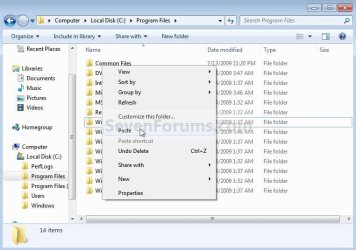
4) Navigate to "C:\Program Files" in Windows Explorer (not "Program Files (x86)" if you have 64-bit Windows), move the extracted and unblocked VBS file into the "C:\Program Files" folder, then close the "Program Files" window.
click any image to enlarge
Cut.jpg

Paste.jpg

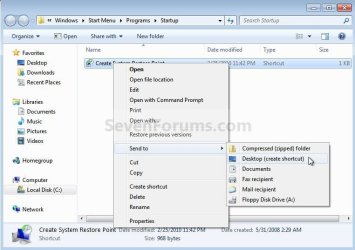
5) Now in the start menu navigate to and r click the "Startup File" to open the "Startup" file window; now back at the "Restore_Point Shortcut" window r click the "Create System Restore Point" shortcut and click cut, then in the "Startup" window at an empty spot click paste. A) Now if you want a shortcut on the desktop to create a restore point whenever needed (without restarting the PC) r click the "Instant Restore Point" shortcut in the "Startup" window and select "Send to, Desktop (create shortcut)" to place a shortcut on the desktop.
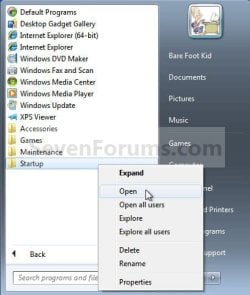
Start.jpg

Desktop Shortcut.jpg

6) You're done, now close all the windows and if you want, the zip and the restore point files that you downloaded can be deleted from the desktop.

To use the shortcut you just created.

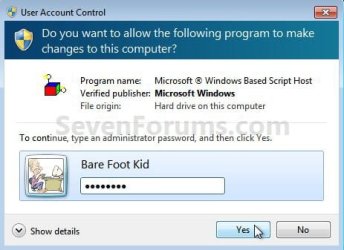
7) Whenever the PC boots to the desktop the first prompt you'll get is "Do you want to open this file?" click open then enter your user credentials for the UAC prompt and click yes.
click any image to enlarge
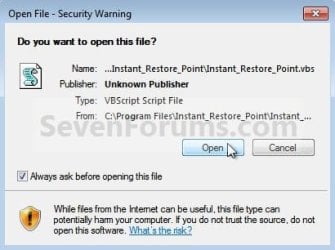
File Prompt.jpg

Prompt.jpg

8) If you have chosen to use the restore point creator with a description this last snip is the last step in the process, enter the description you want to use and click ok to finish up, that's all there is to it. I use the one with no description and with 2 clicks at bootup it's done.
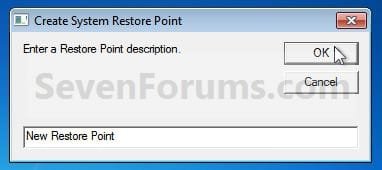
Description.jpg


Method Two

Windows Task Scheduler


1) Start by downloading this zip file to the Windows desktop.
Scheduled_Instant_Restore_Point.zip

Download


2) Open the downloaded zip file, extract (drag and drop) the VBS file to the desktop, and unblock the VBS file.

3) Navigate to "C:\Program Files" in Windows Explorer (not "Program Files (x86)" if you have 64-bit Windows), move the extracted and unblocked VBS file into the "C:\Program Files" folder, then close the "Program Files" window.
Cut.jpg

Paste.jpg

4) In the "Access Denied" dialog box that opens click Continue, if you get a UAC prompt, enter your user credentials and click Yes; then just close the Program Files window that opens.

You can now delete the downloaded Zip file from the desktop if you like.
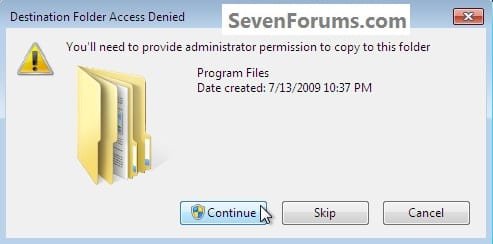
Continue.jpg
Now in the Windows start menu search box type taskschd.msc and hit the <enter> key. In the Task Scheduler window that opens at the right pane Actions column, click Create Task.

5) In the "Create Task" window that opens at the General tab, give the new task a Name, a description is optional, dot "Run whether user ... " put a check/tic at "Run with highest ... " and "Configure for ... " your flavor Windows.
click any image to enlarge
Task_General.jpg
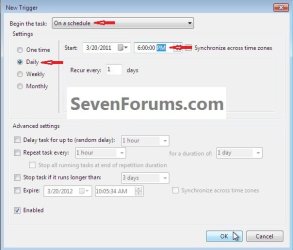
6) Now still in the "Create Task" window click the Triggers tab, at the bottom left click the New button, in the New Trigger dialog box that opens be sure to select when you want the task to run and the daily time you want it to run and click OK.
Task_Trigger.jpg
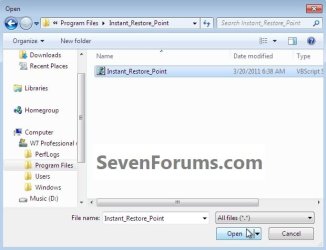
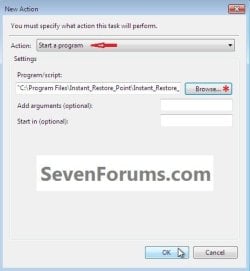
7) Now back at the "Create Task" window click the Actions tab, at the bottom left click the New button, in the New Action dialog box that opens click Browse (see #8 below), now browse to C:\Program Files and click the Instant_Restore_Point file you extracted there in step #2 above and click Open, then click the Instant_Restore_Point script and click Open again.
click any image to enlarge
Action_File.jpg

Action_Script.jpg

8) Now at the New Action dialog box that's still open click OK.
Action.jpg
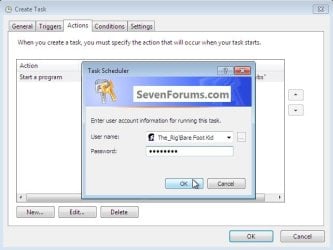
9) In the Create Task window that's still open click OK, in the Account Information dialog box that opens add your user credentials and click OK.

That's all, you are now finished and you can close the Task Scheduler.
Password.jpg
Enjoy! :)
 

Attachments

Last edited by a moderator:
Since they're working, I'd let them be if you like.

Well, according to zemana, the tasks were trojans that exist in the RAM. Could that explain it?
 

My Computer My Computer

Computer type
Laptop
Computer Manufacturer/Model Number
MSI
OS
Windows 10 64 bit

My Computer My Computer

Computer type
PC/Desktop
Computer Manufacturer/Model Number
Self built custom
OS
64-bit Windows 11 Pro for Workstations
CPU
Intel i7-8700K OC'd to 5 GHz
Motherboard
ASUS ROG Maximus XI Formula Z390
Memory
64 GB (4x16GB) G.SKILL TridentZ RGB DDR4 3600 MHz
Graphics Card(s)
ASUS ROG-STRIX-GTX1080TI-O11G-GAMING
Sound Card
Integrated
Monitor(s) Displays
2 x Samsung Odyssey G7 27"
Screen Resolution
2560x1440
Hard Drives
1TB Samsung 990 PRO M.2,
4TB Samsung 990 PRO PRO M.2,
TerraMaster F8 SSD Plus NAS
PSU
Seasonic Prime Titanium 850W
Case
Thermaltake Core P3
Cooling
Corsair Hydro H115i
Keyboard
Logitech wireless K800
Mouse
Logitech MX Master 4
Internet Speed
2 Gb/s Download and 100 Mb/s Upload
Antivirus
Malwarebyte Anti-Malware Premium
Browser
Google Chrome
Other Info
Logitech Z625 speaker system,
Logitech BRIO 4K Pro webcam,
HP Color LaserJet Pro MFP M477fdn,
APC SMART-UPS RT 1000 XL - SURT1000XLI,
Galaxy S23 Plus phone
Auto Restore point not working

Hello All,

great tutorial, many thanks.
I have followed method 2 and task history shows the task ran, however there are no restore points associated. I am running windows 10 64bit, any ideas?

Many thanks
 

My Computer My Computer

Computer type
Laptop
Computer Manufacturer/Model Number
acer
OS
win 10 64bit
Antivirus
Vipre
Browser
FF
Hello All,

great tutorial, many thanks.
I have followed method 2 and task history shows the task ran, however there are no restore points associated. I am running windows 10 64bit, any ideas?

Many thanks

Hello delmonte, and welcome to Seven Forums. :)

Sometimes it may take a few minutes for the restore point to show up in System Restore.

For now, you might see if either tutorial below may work for you instead.

Restore Point Context Menu - Add in Windows 10 - Windows 10 Forums

System Restore Point shortcut - Create in Windows 10 - Windows 10 Forums
 

My Computer My Computer

Computer type
PC/Desktop
Computer Manufacturer/Model Number
Self built custom
OS
64-bit Windows 11 Pro for Workstations
CPU
Intel i7-8700K OC'd to 5 GHz
Motherboard
ASUS ROG Maximus XI Formula Z390
Memory
64 GB (4x16GB) G.SKILL TridentZ RGB DDR4 3600 MHz
Graphics Card(s)
ASUS ROG-STRIX-GTX1080TI-O11G-GAMING
Sound Card
Integrated
Monitor(s) Displays
2 x Samsung Odyssey G7 27"
Screen Resolution
2560x1440
Hard Drives
1TB Samsung 990 PRO M.2,
4TB Samsung 990 PRO PRO M.2,
TerraMaster F8 SSD Plus NAS
PSU
Seasonic Prime Titanium 850W
Case
Thermaltake Core P3
Cooling
Corsair Hydro H115i
Keyboard
Logitech wireless K800
Mouse
Logitech MX Master 4
Internet Speed
2 Gb/s Download and 100 Mb/s Upload
Antivirus
Malwarebyte Anti-Malware Premium
Browser
Google Chrome
Other Info
Logitech Z625 speaker system,
Logitech BRIO 4K Pro webcam,
HP Color LaserJet Pro MFP M477fdn,
APC SMART-UPS RT 1000 XL - SURT1000XLI,
Galaxy S23 Plus phone
Scripts work great.

I have the machine setup to create a restore point at startup, but two more things Id like to do.

1) Bypass the User Account Control. I've tried 3 methods: Task Scheduler, Winaero Elevated Shortcut.exe, and UAC Trust Shortcut.

The first two dont work at all (because they dont work with vbs scripts?).

In the case of UAC Trust Shortcut, when you are fully loaded in windows, it work fine. The problem is that UAC Trust Shortcut must be running to affect the shortcuts it has created. Thus, I have it set to open at startup.

The dilemma here is that when the startup folder shortcuts take effect, the system restore script initializes before the UAC Trust Shortcut program

2) I want to eliminate the "system restore point created successfully" message


thanks
 

My Computer My Computer

Computer type
PC/Desktop
OS
Windows 10 Pro
CPU
Intel Core i5 6500
Motherboard
ASRock Z170 Pro4
Hard Drives
Mushkin MKNSSDRE 1TB SSD
Browser
Firefox 48.02
Hello kitpzyxmsir, and welcome to Seven Forums. :)

You should be able to use Method 2 as is in the tutorial on the first page here to create an instant restore point without a UAC prompt or success message.
 

My Computer My Computer

Computer type
PC/Desktop
Computer Manufacturer/Model Number
Self built custom
OS
64-bit Windows 11 Pro for Workstations
CPU
Intel i7-8700K OC'd to 5 GHz
Motherboard
ASUS ROG Maximus XI Formula Z390
Memory
64 GB (4x16GB) G.SKILL TridentZ RGB DDR4 3600 MHz
Graphics Card(s)
ASUS ROG-STRIX-GTX1080TI-O11G-GAMING
Sound Card
Integrated
Monitor(s) Displays
2 x Samsung Odyssey G7 27"
Screen Resolution
2560x1440
Hard Drives
1TB Samsung 990 PRO M.2,
4TB Samsung 990 PRO PRO M.2,
TerraMaster F8 SSD Plus NAS
PSU
Seasonic Prime Titanium 850W
Case
Thermaltake Core P3
Cooling
Corsair Hydro H115i
Keyboard
Logitech wireless K800
Mouse
Logitech MX Master 4
Internet Speed
2 Gb/s Download and 100 Mb/s Upload
Antivirus
Malwarebyte Anti-Malware Premium
Browser
Google Chrome
Other Info
Logitech Z625 speaker system,
Logitech BRIO 4K Pro webcam,
HP Color LaserJet Pro MFP M477fdn,
APC SMART-UPS RT 1000 XL - SURT1000XLI,
Galaxy S23 Plus phone
Hello kitpzyxmsir, and welcome to Seven Forums. :)

You should be able to use Method 2 as is in the tutorial on the first page here to create an instant restore point without a UAC prompt or success message.
Hi Brink,

The main reason I have been using a combination of methods for eliminating the UAC during startup of specific items is that, for me, none of the methods work on all file types.

I would prefer to always use the "scheduled task" method for this purpose, but I have never been able to initialize any VBS file in that environment

The Method 2 scenario wasnt exactly what I was looking for, but the Instant_Restore_Point.vbs would be ideal for working silently in the background whenever windows boots up.

However, I did set up Method 2 as-is (well, not exactly as-is....I made a few changes I hoped would no matter) to see if i could finally get a VBS script to work in there

I tried the daily setting and the one time setting.

It still didnt work.

I never get a password prompt when trying to setup a task because my intent is to eliminate the UAC, not setup a schedule, so the "trigger" in not a factor. I really dont want to have to setup a login password.

Is this the step that is stopping me? Is there something unique about VBS scripts in re passwords or otherwise?

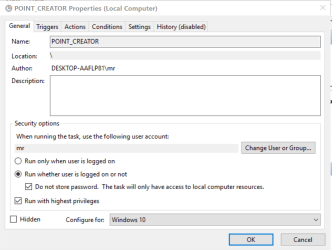
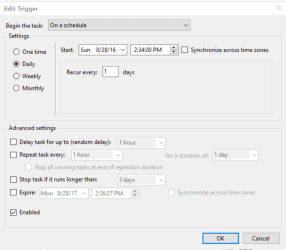
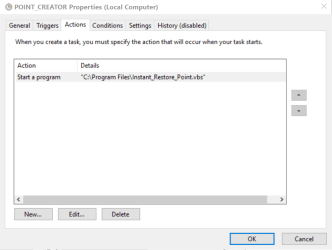
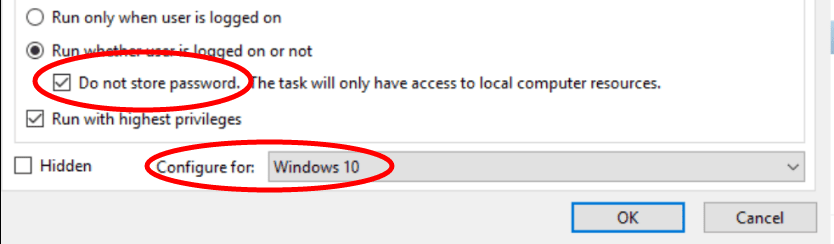
In the screenshots you will see what I did, including "configure for Windows 10"
 

Attachments

  • POINT_CREATOR_1.png
    POINT_CREATOR_1.png
    40.2 KB · Views: 74
  • POINT_CREATOR_2.png
    POINT_CREATOR_2.png
    38.3 KB · Views: 105
  • POINT_CREATOR_3.png
    POINT_CREATOR_3.png
    22.4 KB · Views: 119

My Computer My Computer

Computer type
PC/Desktop
OS
Windows 10 Pro
CPU
Intel Core i5 6500
Motherboard
ASRock Z170 Pro4
Hard Drives
Mushkin MKNSSDRE 1TB SSD
Browser
Firefox 48.02
What changes did you make?

Luckily, you're not prompted for a password in W10.
 

My Computer My Computer

Computer type
PC/Desktop
Computer Manufacturer/Model Number
Self built custom
OS
64-bit Windows 11 Pro for Workstations
CPU
Intel i7-8700K OC'd to 5 GHz
Motherboard
ASUS ROG Maximus XI Formula Z390
Memory
64 GB (4x16GB) G.SKILL TridentZ RGB DDR4 3600 MHz
Graphics Card(s)
ASUS ROG-STRIX-GTX1080TI-O11G-GAMING
Sound Card
Integrated
Monitor(s) Displays
2 x Samsung Odyssey G7 27"
Screen Resolution
2560x1440
Hard Drives
1TB Samsung 990 PRO M.2,
4TB Samsung 990 PRO PRO M.2,
TerraMaster F8 SSD Plus NAS
PSU
Seasonic Prime Titanium 850W
Case
Thermaltake Core P3
Cooling
Corsair Hydro H115i
Keyboard
Logitech wireless K800
Mouse
Logitech MX Master 4
Internet Speed
2 Gb/s Download and 100 Mb/s Upload
Antivirus
Malwarebyte Anti-Malware Premium
Browser
Google Chrome
Other Info
Logitech Z625 speaker system,
Logitech BRIO 4K Pro webcam,
HP Color LaserJet Pro MFP M477fdn,
APC SMART-UPS RT 1000 XL - SURT1000XLI,
Galaxy S23 Plus phone
Luckily, you're not prompted for a password in W10.
Yeh, I dont know if it is still this way, but I learned my lesson the hard way when I first got Win 10, created a microsoft user account from the start menu, and got stuck with an unsolicited and unwanted computer password login

What changes did you make?
 

Attachments

  • POINT_CREATOR_5.png
    POINT_CREATOR_5.png
    17.8 KB · Views: 72

My Computer My Computer

Computer type
PC/Desktop
OS
Windows 10 Pro
CPU
Intel Core i5 6500
Motherboard
ASRock Z170 Pro4
Hard Drives
Mushkin MKNSSDRE 1TB SSD
Browser
Firefox 48.02
Checking "Do not store password" could be the reason why the task is not working.
 

My Computer My Computer

Computer type
PC/Desktop
Computer Manufacturer/Model Number
Self built custom
OS
64-bit Windows 11 Pro for Workstations
CPU
Intel i7-8700K OC'd to 5 GHz
Motherboard
ASUS ROG Maximus XI Formula Z390
Memory
64 GB (4x16GB) G.SKILL TridentZ RGB DDR4 3600 MHz
Graphics Card(s)
ASUS ROG-STRIX-GTX1080TI-O11G-GAMING
Sound Card
Integrated
Monitor(s) Displays
2 x Samsung Odyssey G7 27"
Screen Resolution
2560x1440
Hard Drives
1TB Samsung 990 PRO M.2,
4TB Samsung 990 PRO PRO M.2,
TerraMaster F8 SSD Plus NAS
PSU
Seasonic Prime Titanium 850W
Case
Thermaltake Core P3
Cooling
Corsair Hydro H115i
Keyboard
Logitech wireless K800
Mouse
Logitech MX Master 4
Internet Speed
2 Gb/s Download and 100 Mb/s Upload
Antivirus
Malwarebyte Anti-Malware Premium
Browser
Google Chrome
Other Info
Logitech Z625 speaker system,
Logitech BRIO 4K Pro webcam,
HP Color LaserJet Pro MFP M477fdn,
APC SMART-UPS RT 1000 XL - SURT1000XLI,
Galaxy S23 Plus phone
Checking "Do not store password" could be the reason why the task is not working.
Forgive me for being so persistent about this, but is there something unique about that particular script, that it should require a password, or do all VBS scripts require a password when used with the task scheduler?

Can you think of a reason why this method of disabling the UAC works for other files, but not for VBS scripts (at least in my case).

Could it possibly have something to do with windows 10 itself? Have you had sucesss running this method for VBS on Windows 10?
 

My Computer My Computer

Computer type
PC/Desktop
OS
Windows 10 Pro
CPU
Intel Core i5 6500
Motherboard
ASRock Z170 Pro4
Hard Drives
Mushkin MKNSSDRE 1TB SSD
Browser
Firefox 48.02
The password is to be able to run the task with elevated rights.
 

My Computer My Computer

Computer type
PC/Desktop
Computer Manufacturer/Model Number
Self built custom
OS
64-bit Windows 11 Pro for Workstations
CPU
Intel i7-8700K OC'd to 5 GHz
Motherboard
ASUS ROG Maximus XI Formula Z390
Memory
64 GB (4x16GB) G.SKILL TridentZ RGB DDR4 3600 MHz
Graphics Card(s)
ASUS ROG-STRIX-GTX1080TI-O11G-GAMING
Sound Card
Integrated
Monitor(s) Displays
2 x Samsung Odyssey G7 27"
Screen Resolution
2560x1440
Hard Drives
1TB Samsung 990 PRO M.2,
4TB Samsung 990 PRO PRO M.2,
TerraMaster F8 SSD Plus NAS
PSU
Seasonic Prime Titanium 850W
Case
Thermaltake Core P3
Cooling
Corsair Hydro H115i
Keyboard
Logitech wireless K800
Mouse
Logitech MX Master 4
Internet Speed
2 Gb/s Download and 100 Mb/s Upload
Antivirus
Malwarebyte Anti-Malware Premium
Browser
Google Chrome
Other Info
Logitech Z625 speaker system,
Logitech BRIO 4K Pro webcam,
HP Color LaserJet Pro MFP M477fdn,
APC SMART-UPS RT 1000 XL - SURT1000XLI,
Galaxy S23 Plus phone
The password is to be able to run the task with elevated rights
When the script is "run only when the user is logged on", on a time schedule trigger, not at startup, it works as designed.

Using this method, the Task Scheduler does not require a password to run it with elevated rights.

But, when a vbscript is run "whether the user is logged on or not", at startup, a user password must be established.

Am I wrong in assuming that creating a password will have the residual effect of producing a login screen at startup? Or can it be configured not to do so?
 

My Computer My Computer

Computer type
PC/Desktop
OS
Windows 10 Pro
CPU
Intel Core i5 6500
Motherboard
ASRock Z170 Pro4
Hard Drives
Mushkin MKNSSDRE 1TB SSD
Browser
Firefox 48.02

My Computer My Computer

Computer type
PC/Desktop
Computer Manufacturer/Model Number
Self built custom
OS
64-bit Windows 11 Pro for Workstations
CPU
Intel i7-8700K OC'd to 5 GHz
Motherboard
ASUS ROG Maximus XI Formula Z390
Memory
64 GB (4x16GB) G.SKILL TridentZ RGB DDR4 3600 MHz
Graphics Card(s)
ASUS ROG-STRIX-GTX1080TI-O11G-GAMING
Sound Card
Integrated
Monitor(s) Displays
2 x Samsung Odyssey G7 27"
Screen Resolution
2560x1440
Hard Drives
1TB Samsung 990 PRO M.2,
4TB Samsung 990 PRO PRO M.2,
TerraMaster F8 SSD Plus NAS
PSU
Seasonic Prime Titanium 850W
Case
Thermaltake Core P3
Cooling
Corsair Hydro H115i
Keyboard
Logitech wireless K800
Mouse
Logitech MX Master 4
Internet Speed
2 Gb/s Download and 100 Mb/s Upload
Antivirus
Malwarebyte Anti-Malware Premium
Browser
Google Chrome
Other Info
Logitech Z625 speaker system,
Logitech BRIO 4K Pro webcam,
HP Color LaserJet Pro MFP M477fdn,
APC SMART-UPS RT 1000 XL - SURT1000XLI,
Galaxy S23 Plus phone
Hi Brink,

Before I continue, a couple things I discovered that you might consider adding to the tutorial.

First, my system contains two, different sized, crscript.exe files. The problem is that, for whatever reason, the Scheduled Task will work with one, but not the other. So if your task is unsuccessful, this might be the reason. You may need to try both.

Also, I just did the 1607 Anniversary update, and the I.D. of the crscript.exe files were changed, thus rendering the information in the Task Scheduler “PROGRAM/SCRIPT” field invalid. I don't know how vulnerable this method using crscript.exe is to random updates, but it is something to keep in mind.

However, I found a great alternative method for running a vbscript at startup with no UAC that eliminates the issues with the current tutorial method, no password required, and also has the tiny added benefit of no momentary dos window popup when the script is run.

How to Create a Daily Restore Point Using Task Scheduler in Windows (All Versions)?


A variation of this method can also be used to manually run vbscripts with no UAC inside windows:

1) MOVE THE VBSCRIPT TO BE USED TO C\:WINDOWS
2) OPEN TASK SCHEDULER
2) ON THE “GENERAL” TAB, USE “RUN ONLY WHEN USER IS LOGGED ON”
3) CHECK "RUN WITH HIGHEST PRIVILEGES"
4) SELECT "CONFIGURE FOR WINDOWS 10" (OR YOUR OPERATING SYSTEM)
5) “ACTIONS” TAB > SELECT "NEW" > IN “PROGRAM/SCRIPT” FIELD ENTER “C:\Windows\System32\Wscript.exe” (NO QUOTES)
6) IN “ADD ARGUMENTS (OPTIONAL)” ENTER “FULL PATH OF VBSCRIPT” (NO QUOTES) THAT WAS MOVED TO C:\Windows (EXAMPLE: C:\Windows\automatic_restore_point.vbs), CLICK OK
7) CLOSE TASK SCHEDULER

Thanks for the help and pointing me in the right direction.
 

My Computer My Computer

Computer type
PC/Desktop
OS
Windows 10 Pro
CPU
Intel Core i5 6500
Motherboard
ASRock Z170 Pro4
Hard Drives
Mushkin MKNSSDRE 1TB SSD
Browser
Firefox 48.02
I'm glad to hear that you got it sorted. :)
 

My Computer My Computer

Computer type
PC/Desktop
Computer Manufacturer/Model Number
Self built custom
OS
64-bit Windows 11 Pro for Workstations
CPU
Intel i7-8700K OC'd to 5 GHz
Motherboard
ASUS ROG Maximus XI Formula Z390
Memory
64 GB (4x16GB) G.SKILL TridentZ RGB DDR4 3600 MHz
Graphics Card(s)
ASUS ROG-STRIX-GTX1080TI-O11G-GAMING
Sound Card
Integrated
Monitor(s) Displays
2 x Samsung Odyssey G7 27"
Screen Resolution
2560x1440
Hard Drives
1TB Samsung 990 PRO M.2,
4TB Samsung 990 PRO PRO M.2,
TerraMaster F8 SSD Plus NAS
PSU
Seasonic Prime Titanium 850W
Case
Thermaltake Core P3
Cooling
Corsair Hydro H115i
Keyboard
Logitech wireless K800
Mouse
Logitech MX Master 4
Internet Speed
2 Gb/s Download and 100 Mb/s Upload
Antivirus
Malwarebyte Anti-Malware Premium
Browser
Google Chrome
Other Info
Logitech Z625 speaker system,
Logitech BRIO 4K Pro webcam,
HP Color LaserJet Pro MFP M477fdn,
APC SMART-UPS RT 1000 XL - SURT1000XLI,
Galaxy S23 Plus phone
Thank you so very, very much!
That tutorial was awesome!
I posted this question years ago and somehow got things working - however I've gone through at least 1 HD since then, and now (9/21/18) when I checked - sure enough, it's not creating restore points automatically anymore.
I worked up the nerve to follow your tutorial and, VOILA!, you did it, that turned the trick - now it does it - thanks to you.
I searched and searched, spent hours reading all the posts - then I found yours.
A marvelous solution. Now I can go back to sleep (it's 3:30 AM).

Humbly,
MrBear
 

My Computer My Computer

Computer Manufacturer/Model Number
Dell Inspiron 580
OS
Windows 7 Home Premium 64 bit
CPU
Intel Core i5-760 @ 2.80 ghz
Motherboard
Dell OC2KJT / Intel PCH H57
Memory
8 GB - DDR3-SERAM (1333mhz)
Graphics Card(s)
ATI Radeon HD 5450 - 1 GB
Sound Card
Realtek HD Audio / Intel Display Audio / ATI HI Audio Device
Monitor(s) Displays
Acer AL1916
Hard Drives
Samsung HD103SJ ATA Device
Internet Speed
Comcast Max Blast (150mb)
Antivirus
Norton Security
Browser
Firefox
Other Info
Malwarebytes
Back
Top