A USB cable from the camera to the computer is easiest but the transfer takes longer and the camera has to be kept on, running down the batteries.
One can get external card readers that plug directly into a USB port. Just pull the card from the camera, plug it into the reader, and plug the reader into a USB port. Some readers connect to the computer via a USB cable. Most of those you can leave connected to the computer and just plug in the card at any time.
Then there are the internal card readers. They can be added to a computer although some, especially laptops, already have them built in. I like those because I don't have to keep track of an external card reader or eat up desk space with a cable connected one. This is mine:
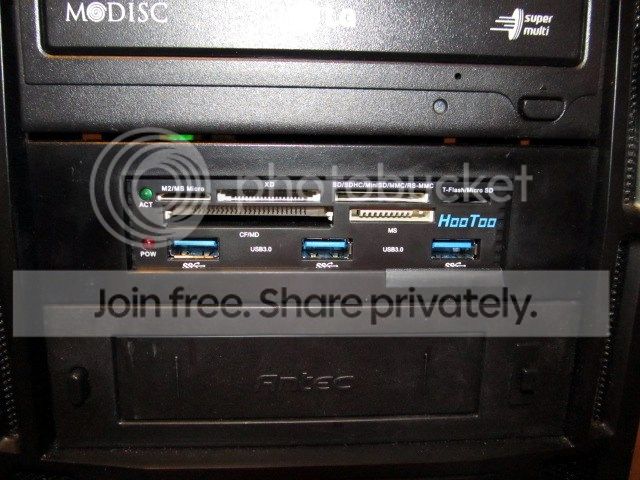
Most card readers, internal and external, connect to the computer by a USB connection. USB 3.0 readers are becoming more available and are needed to realize the full speed potential of the faster cards, such as the Class 10 SDs. My internal reader connects via PCIe 2.0 x1. It can handle one device (cards, USB sticks, etc.) at full speed although adding a second device doesn't noticeably slow anything down. It probably would be able to handle more at full speed if the connection was PCIe 3.0 x1.
One can get external card readers that plug directly into a USB port. Just pull the card from the camera, plug it into the reader, and plug the reader into a USB port. Some readers connect to the computer via a USB cable. Most of those you can leave connected to the computer and just plug in the card at any time.
Then there are the internal card readers. They can be added to a computer although some, especially laptops, already have them built in. I like those because I don't have to keep track of an external card reader or eat up desk space with a cable connected one. This is mine:
Most card readers, internal and external, connect to the computer by a USB connection. USB 3.0 readers are becoming more available and are needed to realize the full speed potential of the faster cards, such as the Class 10 SDs. My internal reader connects via PCIe 2.0 x1. It can handle one device (cards, USB sticks, etc.) at full speed although adding a second device doesn't noticeably slow anything down. It probably would be able to handle more at full speed if the connection was PCIe 3.0 x1.
My Computer
At a glance
Win 7 Ultimate 64 bitIntel i7-3930KKingston HyperX Genesis 32GB Kit (8x4GB Modul...MSI R7850 Twin Frozr 2GD5/OC Radeon HD 7850 2...
- Computer type
- PC/Desktop
- Computer Manufacturer/Model Number
- Custom Build
- OS
- Win 7 Ultimate 64 bit
- CPU
- Intel i7-3930K
- Motherboard
- ASUS P9X79 WS
- Memory
- Kingston HyperX Genesis 32GB Kit (8x4GB Modules) 1600MHz DDR
- Graphics Card(s)
- MSI R7850 Twin Frozr 2GD5/OC Radeon HD 7850 2GB 256-bit GDDR
- Sound Card
- Asus Xonar Essence STX
- Monitor(s) Displays
- 3x Asus VG248QE 24", Vizio 32" TV
- Screen Resolution
- 1920 x 1080, ?
- Hard Drives
- Samsung 128GB 840 Pro SSD (1),
Samsung 4TB 850 EVO SSDs (4)
Samsung 4TB 850 EVO SSDs (16) external backup drives used in 2.5" hot swap bays in the computer.
- PSU
- Corsair HX750w
- Case
- Antec Two Hundred v2 (modified)
- Cooling
- Cooler Master GeminII S524 120mm (fan replaced with a 140mm)
- Keyboard
- Logitech G510s
- Mouse
- Logitech M525 (two in use)
- Internet Speed
- =< 32Mbps down, 8Mbps up
- Antivirus
- AVAST!, MBAM, SAS, Spybot S&D (all but MBAM free) Glary Util
- Browser
- IE11
- Other Info
- LSI 9211-8i HBA card (8 SATA III ports), 2.5" & 3.5" Hot Swap Bays, HooToo HT-CR001 PCI-E to USB 3.0 Internal Hub + 6 Slot Card Reader, and LG Model CH12LS28 BD-ROM Optical Drive. Also, ScanSnap S1500 ADF duplexing scanner, Canon 9000F flat bed scanner, Corsair SP2500 2.1 speakers, Samsung CLP 415nw laser color printer, Cyberpower PP2200SW UPS