
How to Enable or Disable Internet Explorer InPrivate Browsing
Information
InPrivate Browsing prevents Internet Explorer 8, Internet Explorer 9, and Internet Explorer 10 from storing data about a user's browsing session. This includes cookies, temporary Internet files, history, and other data. Toolbars and extensions are disabled by default.
This tutorial will show you how to enable or disable the ability to use the InPrivate Browsing feature in IE8, IE9, or IE10 for all or specific users on the computer.
You must be logged in as an administrator to be able to do the steps in this tutorial.
This tutorial will show you how to enable or disable the ability to use the InPrivate Browsing feature in IE8, IE9, or IE10 for all or specific users on the computer.
You must be logged in as an administrator to be able to do the steps in this tutorial.
Note
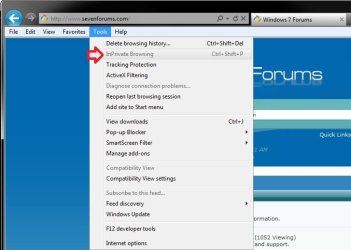
When disabled, the InPrivate Browsing option in Internet Explorer will be grayed out and not be able to open and turn on Inprivate Browsing.
Warning
This can only be done while logged in as a administrator.
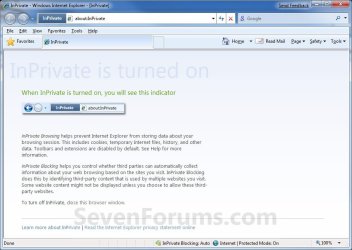
EXAMPLE: Internet Explorer InPrivate Browsing
NOTE: This is the default window you will see when you open a InPrivate Browsing window when it is enabled. Notice how you will have a InPrivate indicator to the left of the address bar to let you know that you have InPrivate Browsing turned on.
OPTION ONE
To Enable or Disable "IE InPrivate Browsing" using a REG File Download
NOTE: This option will affect all users on the computer.
1. To Enable InPrivate Browsing in IE9 or IE10 for All Users
NOTE: This is the default setting.
A) Click/tap on the Download button below to download the file below.
Enable_InPrivate_Browsing.reg
Download
B) Go to step 3.
2. To Disable InPrivate Browsing in IE9 or IE10 for All Users
A) Click/tap on the Download button below to download the file below.
Disable_InPrivate_Browsing.reg
Download
3. Save the .reg file to the desktop.
4. Double click/tap on the downloaded .reg file to merge it.
5. Click/tap on Run, Yes (UAC-Windows 7/8) or Continue (UAC-Vista), Yes, and OK when prompted.
6. Log off and log on, or restart the computer to fully apply.
7. When done, you can delete the downloaded .reg file if you like.
OPTION TWO
To Enable or Disable "IE InPrivate Browsing" in Local Group Policy Editor
1. Open the all users, specific users or groups, or all users except administrators Local Group Policy Editor for how you want this policy applied.
2. If you have Internet Explorer 8 Installed
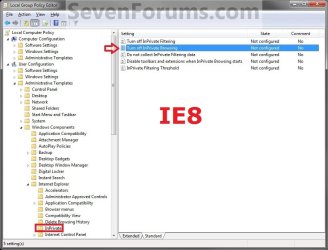
A) In the left pane, click/tap on to expand User Configuration, Administrative Templates, Windows Components, Internet Explorer, and InPrivate. (See screenshot below)
B) Go to step 4.
3. If you have IE9 or IE10 Installed
A) In the left pane, click/tap on to expand User Configuration, Administrative Templates, Windows Components, Internet Explorer, and Privacy. (see screenshot below)
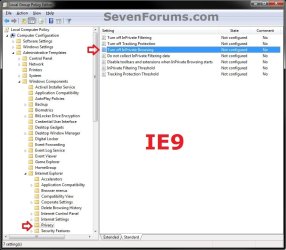
4. In the right pane, double click/tap on Turn off InPrivate Browsing to edit it. (see screenshot above)
5. To Enable InPrivate Browsing
A) Select (dot) either Not Configured or Disabled. (see screenshot below step 7)
NOTE: Not Configured is the default setting.
B) Go to step 7.
6. To Disable InPrivate Browsing
A) Select (dot) Enabled. (see screenshot below step 7)
7. Click/tap on OK. (See screenshot below)

8. Close the Local Group Policy Editor window.
9. If open, close and reopen Internet Explorer to fully apply.
That's it,
Shawn
Related Tutorials
- How to Open an Internet Explorer InPrivate Browsing Window
- How to Open Internet Explorer InPrivate Browsing in Windows 8 and 8.1
- How to Create an Internet Explorer InPrivate Browsing Shortcut
- How to Enable or Disable Toolbars and Extensions in Internet Explorer InPrivate Browsing
- How to Turn InPrivate Filtering On or Off in Internet Explorer 8
Attachments
Last edited:


