SSD / HDD : Optimize for Windows Reinstallation

How to Optimize an SSD / HDD When You're Ready to Reinstall the Operating System

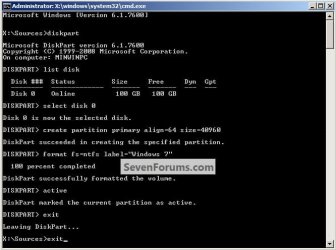
This will show how to remove / over-write all existing data from a Solid State Drive (SSD) or a Hard Disk Drive (HDD), it'll work for both, then how to create a partition and then format that partition before install begins so you have a clean drive to start the installation with.

   Note

Before you start this, in the Windows start menu search box type diskmgmt.msc right click the entry and click "Run as Administrator" if you get a User Account Control (UAC) prompt enter your user credentials and click Yes; make very sure you know the correct drive number of the drive you want to do this to if you have more than one SSD / HDD in the machine, you don't want to do the wrong one.
   Warning

Do not do this to any SSD or HDD that has data on it you don't want to lose, the first thing this does is to mark the drive as "Unallocated Space" and then writes zeroes ( 0's ) to the entire drive, it's known as a "Secure Erase" and it will make data un-recoverable, it cannot be done to just a single partition on a drive, it will do the whole drive.
You have been warned!
   Information

It may be a help to over-write the HDD Master Boot Record (MBR) before you start any other procedure using the diskpart clean command, rather than the clean all; it takes just seconds to complete so you will have "unallocated" space to use either the Windows installer to create and format the partition(s) or use diskpart for that, however you choose.

Let's get started!


Step One

Boot To DISKPART


If need be, view this tutorial at the link below for an out-line of the process.
How to Boot to DISKPART at PC Startup

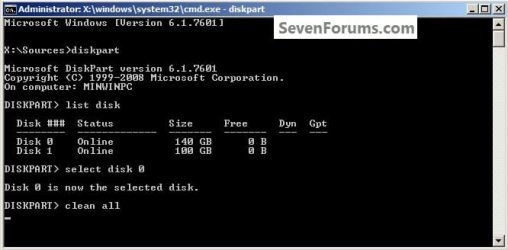
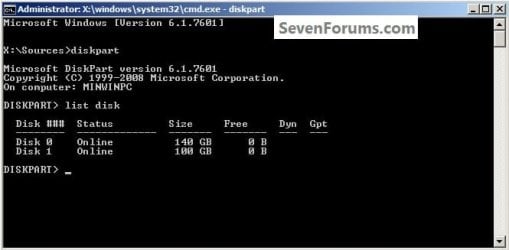
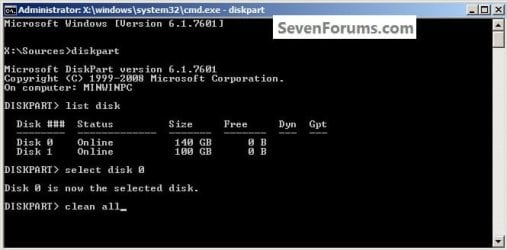
1) In the command window that opens type diskpart then hit the <enter> key then type list disk <enter> if you have more than one SSD / HDD in the machine it'll list them all.

Have a look here to view additional important information on this entire process.
click any image to enlarge
One_1.jpg
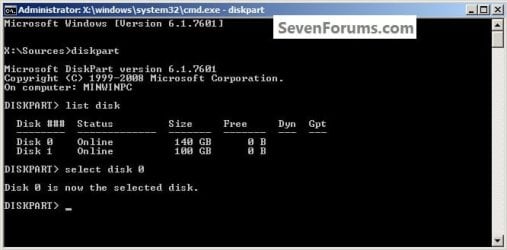
2) Now in the command window type select disk # (# = target disk number) then <enter>, you will get "Disk # is now the selected disk".
One_2.jpg
3) Now type clean <enter> you will get a blinking cursor telling you that clean all is working like in the second snip down, just relax and let it work.
One_3.1.jpg
One_3.2.jpg
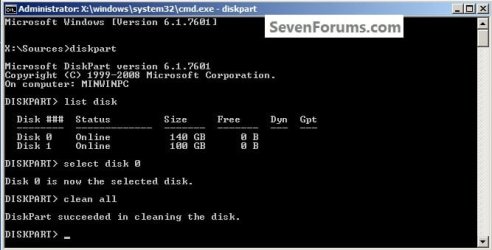
4) When it finishes you'll get "DiskPart succeeded in cleaning the disk" in the command window.
One_4.1.jpg
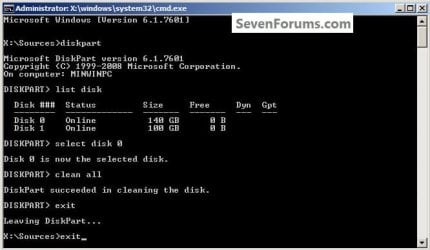
To leave diskpart at any time and return to the Windows 7 installer type exit two (2) separate times and hit <enter> after each and you will be returned to the installer to continue the installation process.
One_4.2.jpg


Step Two

Create a Partition


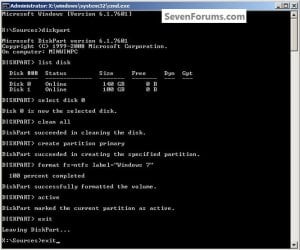
1) Create a single partition of the entire HDD / SSD

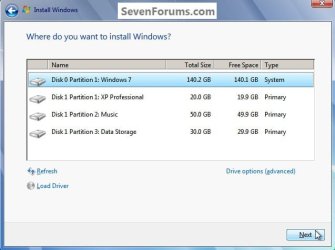
Still in the same command window, to create a partition of the entire HDD / SSD, it is suggested if you are using one of the larger, 1 - 2TB HDDs that you use the outline in #2 below to create a single 100GB partition to do the installation to or #3 below if you would like to include the new Windows 7 System Reserved partition, as we're now seeing serious issues with some trying to install to such large partitions.

Do not format the created partition(s) with the installer if you create them using this process as the installer will delete all this info, the second snip shows how to select "where to install" during the installation process, click to highlight/select the "Windows 7" partition and click next.

Now skip down to #5 below to start the installation.
click any image to enlarge
Two_1.1.jpg
Two_1.2.jpg
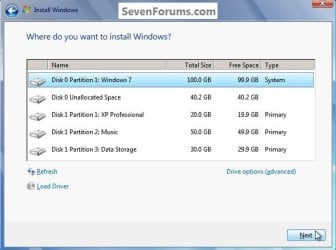
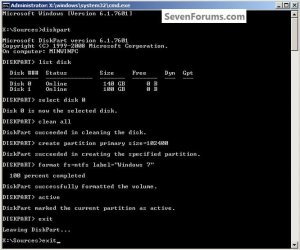
2) Create a specific size partition

If you wanted to create a specific size partition, say 100GB you would add the size you want to create in MBs like in the command below.
create partition primary size=102400 <enter>
1024MB = 1GB - 1024x100 = 102400, you can use/create any size you like.

You can always extend the Windows partition to include the remaining unallocated space on the HDD / SSD or create additional Primary partitions or an Extended partition after the installation completes if you choose.

Do not format the created partition(s) with the installer if you create them using this process as the installer will delete all this info, the second snip shows how to select "where to install" during the installation process, click to highlight/select the "Windows 7" partition and click next.

Now skip down to #5 below to start the installation.
Two_2.1.jpg
Two_2.2.jpg
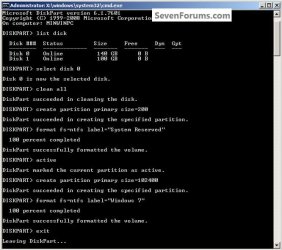
3) Create the System Reserved partition

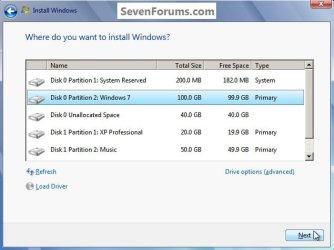
If you should want to add the "System Reserved" partition back after the clean all, see this snip; of course you would have to select to install Windows 7 to the partition labeled as "Windows 7" during the install and do not format either partition with the installer.

The reason for suggesting to create the System Reserved at 200MB instead of the new default of 100MB is an attempt to curb some of the issues we're now seeing with the partition being too small when dual/multi booting and it also being needed for use with the Windows 7 Backup and Restore and BitLocker programs.

You can always extend the Windows partition to include the remaining unallocated space on the HDD / SSD or create additional Primary partitions or an Extended partition after the installation completes if you choose.

The second snip shows how to select "where to install" during the installation process, click to highlight/select the "Windows 7" partition and click next.
Two_3.1.jpg
Two_3.2.jpg
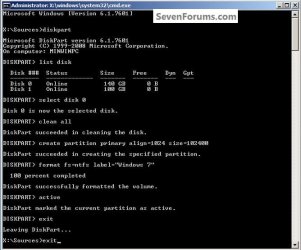
4) See this tutorial for the "align" argument

Align a Solid State Drive for Windows Installation
Two_4.1.jpg
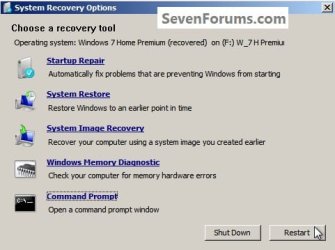
5) That's it, you're now done with the command window, type exit <enter> to leave diskpart and exit <enter> again to close the command window; if you're using a Windows 7 full installer it will go to the "Select Language" screen to continue the installation process as usual.

For those using a created repair CD or a Vista installer type exit <enter> to leave diskpart and exit <enter> again to close the command window; at the System Recovery Options dialog box that's still open click Restart to finish the process.
Restart.jpg
Enjoy! :)


Last edited by a moderator:
Beautiful! Thanks a million!

I guess there's nothing left to do but do it - install Windows...!

Thanks again you guys. Your help is very much appreciated.

I'll post an update after...
 

My Computer

Computer type
PC/Desktop
OS
Win7 Pro 64-bit sp1
CPU
core i7 980X
Motherboard
MSI Big-Bang XPower X58
Memory
G.Skill 4Gx3 F3-10666CL9T-12GBRL (x2)
Graphics Card(s)
EVGA 06G-P4-3787-KR
Monitor(s) Displays
HP LP2475w (x2)
Screen Resolution
3840x1200
Hard Drives
Crucial RealSSD CTFDDAC128MAG-1G1 (boot drive);
Crucial m4 128GB;
Samsung 1TB HD103SJ 32M 7200rpm (x2);
WD Black WD2002FAEX 2TB (x2)
PSU
Corsair CMPSU-850HX
Case
HAF X
Cooling
Intel DBX-B (stock)
I just added this snip below under Step Two in the "Note" box to make it more accessible.


click to enlarge
Diskpart_Commands.jpg
 

My Computer

Computer Manufacturer/Model Number
* BFK Customs *
OS
W 7 64-bit Ultimate
CPU
Intel Q9550 Yorkfield
Motherboard
ASUS P5Q Pro
Memory
8GB Dominator 8500C5D
Graphics Card(s)
ATI : XFX 5870
Sound Card
Realtek HD Audio 7-1
Monitor(s) Displays
1x 47" LCD HDMI & 3x 26" LCD HDMI
Screen Resolution
1920x1080P & 1920x1200
Hard Drives
1x 80GB Intel X25-M G2 SSD : 1x 500GB & 1x 640GB WD Caviar Black(s)
PSU
Corsair 620HX
Case
Cooler Master RC-690
Cooling
Tuniq Tower 120, 2x 140mm and 3x 120mm case fans
Keyboard
Microsoft 500
Mouse
Razer Diamondback 3G
Internet Speed
14 Mb/s
Other Info
1x Koutech 3Gb/s SATA HDD Hot Swap Rack
Uh-oh - I didn't do that - make it active.

I've done everything in Method One and Windows is happily expanding its files as I write this.

Being that I only created one partition, (crossing fingers) won't it default to making that the active one?

I'd read up on Diskpart so I knew I could format there, but I figured I'd let Windows do it. Same thing right?

as far as designating it active - I have to believe since it's the only partition it's the active one...?

Thanks BFK for all your help and your excellent work on this site - truly one of the very best on the web for Windows 7 imho.
 

My Computer

Computer type
PC/Desktop
OS
Win7 Pro 64-bit sp1
CPU
core i7 980X
Motherboard
MSI Big-Bang XPower X58
Memory
G.Skill 4Gx3 F3-10666CL9T-12GBRL (x2)
Graphics Card(s)
EVGA 06G-P4-3787-KR
Monitor(s) Displays
HP LP2475w (x2)
Screen Resolution
3840x1200
Hard Drives
Crucial RealSSD CTFDDAC128MAG-1G1 (boot drive);
Crucial m4 128GB;
Samsung 1TB HD103SJ 32M 7200rpm (x2);
WD Black WD2002FAEX 2TB (x2)
PSU
Corsair CMPSU-850HX
Case
HAF X
Cooling
Intel DBX-B (stock)
You are correct, it will automatically be marked as active with no problem, some just want that option for other circumstances and it's easier to include it in the tutorial to save time; though in dual boot configs and repair situations it's a needed option for the ones that know how to use it effectively.


I'm glad to see you're getting along good and you are welcome!
 

My Computer

Computer Manufacturer/Model Number
* BFK Customs *
OS
W 7 64-bit Ultimate
CPU
Intel Q9550 Yorkfield
Motherboard
ASUS P5Q Pro
Memory
8GB Dominator 8500C5D
Graphics Card(s)
ATI : XFX 5870
Sound Card
Realtek HD Audio 7-1
Monitor(s) Displays
1x 47" LCD HDMI & 3x 26" LCD HDMI
Screen Resolution
1920x1080P & 1920x1200
Hard Drives
1x 80GB Intel X25-M G2 SSD : 1x 500GB & 1x 640GB WD Caviar Black(s)
PSU
Corsair 620HX
Case
Cooler Master RC-690
Cooling
Tuniq Tower 120, 2x 140mm and 3x 120mm case fans
Keyboard
Microsoft 500
Mouse
Razer Diamondback 3G
Internet Speed
14 Mb/s
Other Info
1x Koutech 3Gb/s SATA HDD Hot Swap Rack
ah great - I was pretty sure it had to default to "active." It's still a relief to hear you confirm it!

Yes, I'm downloading and installing updates now - the installation appears to be going smoothly so far.

Thanks!
 

My Computer

Computer type
PC/Desktop
OS
Win7 Pro 64-bit sp1
CPU
core i7 980X
Motherboard
MSI Big-Bang XPower X58
Memory
G.Skill 4Gx3 F3-10666CL9T-12GBRL (x2)
Graphics Card(s)
EVGA 06G-P4-3787-KR
Monitor(s) Displays
HP LP2475w (x2)
Screen Resolution
3840x1200
Hard Drives
Crucial RealSSD CTFDDAC128MAG-1G1 (boot drive);
Crucial m4 128GB;
Samsung 1TB HD103SJ 32M 7200rpm (x2);
WD Black WD2002FAEX 2TB (x2)
PSU
Corsair CMPSU-850HX
Case
HAF X
Cooling
Intel DBX-B (stock)
Glad to 'hear' all is going well.


I didn't think to mention it until now but you did set the motherboard "Storage Configuration" to AHCI before you started the install, it does make a difference with SSDs, if not, it's not too late, have a look at this tutorial the link below.

Though if you didn't, run the WEI before and after to see the difference.

AHCI : Enable in Windows 7 / Vista
 

My Computer

Computer Manufacturer/Model Number
* BFK Customs *
OS
W 7 64-bit Ultimate
CPU
Intel Q9550 Yorkfield
Motherboard
ASUS P5Q Pro
Memory
8GB Dominator 8500C5D
Graphics Card(s)
ATI : XFX 5870
Sound Card
Realtek HD Audio 7-1
Monitor(s) Displays
1x 47" LCD HDMI & 3x 26" LCD HDMI
Screen Resolution
1920x1080P & 1920x1200
Hard Drives
1x 80GB Intel X25-M G2 SSD : 1x 500GB & 1x 640GB WD Caviar Black(s)
PSU
Corsair 620HX
Case
Cooler Master RC-690
Cooling
Tuniq Tower 120, 2x 140mm and 3x 120mm case fans
Keyboard
Microsoft 500
Mouse
Razer Diamondback 3G
Internet Speed
14 Mb/s
Other Info
1x Koutech 3Gb/s SATA HDD Hot Swap Rack
Yes I did do that beforehand - thanks for the reminder.

best part - my partition is aligned!! It says the offset is 64KB just like you recommended, and I understand as long as your offset is an integer divisible by 4 you're good to go. Not sure whether it makes a difference - depends who you read I guess - but it's nice to have it setup that way anyway!

I have a few questions about what I see in Device Manager. Should I start a new thread for those?

Anyway - thanks very much for the tutorials.
 

My Computer

Computer type
PC/Desktop
OS
Win7 Pro 64-bit sp1
CPU
core i7 980X
Motherboard
MSI Big-Bang XPower X58
Memory
G.Skill 4Gx3 F3-10666CL9T-12GBRL (x2)
Graphics Card(s)
EVGA 06G-P4-3787-KR
Monitor(s) Displays
HP LP2475w (x2)
Screen Resolution
3840x1200
Hard Drives
Crucial RealSSD CTFDDAC128MAG-1G1 (boot drive);
Crucial m4 128GB;
Samsung 1TB HD103SJ 32M 7200rpm (x2);
WD Black WD2002FAEX 2TB (x2)
PSU
Corsair CMPSU-850HX
Case
HAF X
Cooling
Intel DBX-B (stock)
You would get better help in the correct forum; good to see you have this side sorted.


Click Here to start a new thread.
 

My Computer

Computer Manufacturer/Model Number
* BFK Customs *
OS
W 7 64-bit Ultimate
CPU
Intel Q9550 Yorkfield
Motherboard
ASUS P5Q Pro
Memory
8GB Dominator 8500C5D
Graphics Card(s)
ATI : XFX 5870
Sound Card
Realtek HD Audio 7-1
Monitor(s) Displays
1x 47" LCD HDMI & 3x 26" LCD HDMI
Screen Resolution
1920x1080P & 1920x1200
Hard Drives
1x 80GB Intel X25-M G2 SSD : 1x 500GB & 1x 640GB WD Caviar Black(s)
PSU
Corsair 620HX
Case
Cooler Master RC-690
Cooling
Tuniq Tower 120, 2x 140mm and 3x 120mm case fans
Keyboard
Microsoft 500
Mouse
Razer Diamondback 3G
Internet Speed
14 Mb/s
Other Info
1x Koutech 3Gb/s SATA HDD Hot Swap Rack
Will do "Kid" - thanks again!

turned out it was just a driver update issue - SSD was giving me 5.9 in WEI, now I'm rockin with a 7.8. Guess I can live with that :)
 
Last edited:

My Computer

Computer type
PC/Desktop
OS
Win7 Pro 64-bit sp1
CPU
core i7 980X
Motherboard
MSI Big-Bang XPower X58
Memory
G.Skill 4Gx3 F3-10666CL9T-12GBRL (x2)
Graphics Card(s)
EVGA 06G-P4-3787-KR
Monitor(s) Displays
HP LP2475w (x2)
Screen Resolution
3840x1200
Hard Drives
Crucial RealSSD CTFDDAC128MAG-1G1 (boot drive);
Crucial m4 128GB;
Samsung 1TB HD103SJ 32M 7200rpm (x2);
WD Black WD2002FAEX 2TB (x2)
PSU
Corsair CMPSU-850HX
Case
HAF X
Cooling
Intel DBX-B (stock)
Hello all,

I could really use some help in getting my SSD up and running again.

I've been using a Crucial C300 128 GB SSD to run Windows 7 Ultimate x64, but yesterday upon resuming from Sleep mode it crashed, and since then I've been unable to start Windows. It will go to the "Starting Windows" screen with the pulsing logo and never move forward.

I've since given up on the data currently in that SSD and would just like to be able to use it again. As such, I've followed the tutorial posted here, but when I get to the command prompt and try to run diskpart, I get the line:
"On computer: MINWINPC"
and a blinking cursor. Nothing happens.

Does this mean my SSD is dead?

Any help would be much appreciated. Thanks!
 

My Computer

OS
Windows 7 Ultimate x64
CPU
i7 930
Motherboard
Asus P6X58D Premium
Memory
3x2GB Corsair Dominator
Graphics Card(s)
nVidia GTX 280
Hard Drives
Crucial C300 128 GB SSD
PSU
Corsair 750W
This means you are in WIN RE mode, possible cause is the boot files are corrupted.

Try running Startup Repair:

You might need to run it three times as it can only fix one issue at a time.

Let us know if this helps.
 

My Computer

Computer type
PC/Desktop
Computer Manufacturer/Model Number
76~2.0
OS
Windows 7 Ult x64 - SP1/ Windows 8 Pro x64
CPU
Intel Core i5-3570K 4.6GHz
Motherboard
Gigabyte GA-Z77X UD3H, f18
Memory
8GB (2X4GB) DDR3 1600 Corsair Vengeance CL8 1.5v
Graphics Card(s)
Sapphire HD 7770 Vapor-X OC 1GB DDR5
Sound Card
Onboard VIA VT2021
Monitor(s) Displays
22" LCD Dell
Screen Resolution
1680x1050
Hard Drives
Samsung 840Pro 128GB SSD,
Seagate Barracuda 500GB SATA2 7200rpm 32MB cache, Seagate Barracuda 1TB SATA2 7200rpm 32MB cache,
PSU
Corsair HX650W
Case
Cooler Master Storm Scout
Cooling
Corsair H80 2x12cm Noctua NF P12 , 2x14cm case fans
Keyboard
Logitech Wave
Mouse
CM Sentinel
Internet Speed
Dismal
Antivirus
Avast
Browser
Opera Next
Other Info
Haswell laptop: HP Envy 17t-j, i7-4700MQ, GeForce 740M 2GB DDR3, 17.3" Full HD 1920x1080, 16GB RAM, Samsung 840 Pro 128GB, 1TB Hitachi 7200 HDD,
Desktop: eSATA ports,
External eSATA Seagate 500GB SATA2 7200rpm,
External WD USB 500GB
Hi Dave,

Thanks for the link; I tried to follow it, but I couldn't seem to get it to work.

I booted up using my Windows 7 installation disc, but when I select "Repair your computer," I only see the blank blue background; there's no menu for me to choose what OS I would like to restore. I can only assume this means either there's a problem with the SSD connection itself, or the Win7 installation on the SSD is not being detected.

Any thoughts?
 

My Computer

OS
Windows 7 Ultimate x64
CPU
i7 930
Motherboard
Asus P6X58D Premium
Memory
3x2GB Corsair Dominator
Graphics Card(s)
nVidia GTX 280
Hard Drives
Crucial C300 128 GB SSD
PSU
Corsair 750W
Hello derp55, welcome to Seven Forums!


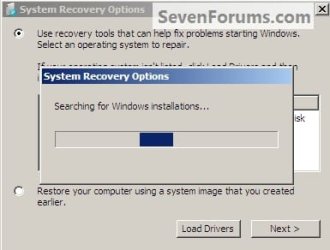
After you select "Repair your ..." you don't get a dialog box like this, "searching"?


click to enlarge
Search.jpg
 

My Computer

Computer Manufacturer/Model Number
* BFK Customs *
OS
W 7 64-bit Ultimate
CPU
Intel Q9550 Yorkfield
Motherboard
ASUS P5Q Pro
Memory
8GB Dominator 8500C5D
Graphics Card(s)
ATI : XFX 5870
Sound Card
Realtek HD Audio 7-1
Monitor(s) Displays
1x 47" LCD HDMI & 3x 26" LCD HDMI
Screen Resolution
1920x1080P & 1920x1200
Hard Drives
1x 80GB Intel X25-M G2 SSD : 1x 500GB & 1x 640GB WD Caviar Black(s)
PSU
Corsair 620HX
Case
Cooler Master RC-690
Cooling
Tuniq Tower 120, 2x 140mm and 3x 120mm case fans
Keyboard
Microsoft 500
Mouse
Razer Diamondback 3G
Internet Speed
14 Mb/s
Other Info
1x Koutech 3Gb/s SATA HDD Hot Swap Rack
Hi Bare Foot Kid.

Unfortunately, no. I got the little spinning circle ribbon indicating it was thinking/processing something, and then it changed back to the regular white mouse cursor, but there was nothing else; no dialogs or popups, just the blue background.

I'm not sure if this helps, but when nothing happened after 20 minutes I tried pressing <Shift> + F10 and also <Esc> just to make sure it was still responsive.

Pressing <Shift> + F10 brought up the command prompt as usual.

Pressing <Esc> brought up a popup asking if I wanted to quit the installation; when I gave confirmation it did not take me back to the page with the "Install Now" and "Repair your computer" options like it normally would, but just sat there with an empty blue background.
 

My Computer

OS
Windows 7 Ultimate x64
CPU
i7 930
Motherboard
Asus P6X58D Premium
Memory
3x2GB Corsair Dominator
Graphics Card(s)
nVidia GTX 280
Hard Drives
Crucial C300 128 GB SSD
PSU
Corsair 750W
Hi Bare Foot Kid.

Unfortunately, no. I got the little spinning circle ribbon indicating it was thinking/processing something, and then it changed back to the regular white mouse cursor, but there was nothing else; no dialogs or popups, just the blue background.

I'm not sure if this helps, but when nothing happened after 20 minutes I tried pressing <Shift> + F10 and also <Esc> just to make sure it was still responsive.

Pressing <Shift> + F10 brought up the command prompt as usual.

Pressing <Esc> brought up a popup asking if I wanted to quit the installation; when I gave confirmation it did not take me back to the page with the "Install Now" and "Repair your computer" options like it normally would, but just sat there with an empty blue background.


Does the SSD manufacturer have any diagnostic utilities you could use to check if in fact the SSD is bad?
 

My Computer

Computer Manufacturer/Model Number
* BFK Customs *
OS
W 7 64-bit Ultimate
CPU
Intel Q9550 Yorkfield
Motherboard
ASUS P5Q Pro
Memory
8GB Dominator 8500C5D
Graphics Card(s)
ATI : XFX 5870
Sound Card
Realtek HD Audio 7-1
Monitor(s) Displays
1x 47" LCD HDMI & 3x 26" LCD HDMI
Screen Resolution
1920x1080P & 1920x1200
Hard Drives
1x 80GB Intel X25-M G2 SSD : 1x 500GB & 1x 640GB WD Caviar Black(s)
PSU
Corsair 620HX
Case
Cooler Master RC-690
Cooling
Tuniq Tower 120, 2x 140mm and 3x 120mm case fans
Keyboard
Microsoft 500
Mouse
Razer Diamondback 3G
Internet Speed
14 Mb/s
Other Info
1x Koutech 3Gb/s SATA HDD Hot Swap Rack
I just checked the Crucial site and couldn't find anything in the form of diagnostic tools. There was also nothing that came with the SSD itself.
 

My Computer

OS
Windows 7 Ultimate x64
CPU
i7 930
Motherboard
Asus P6X58D Premium
Memory
3x2GB Corsair Dominator
Graphics Card(s)
nVidia GTX 280
Hard Drives
Crucial C300 128 GB SSD
PSU
Corsair 750W
I just checked the Crucial site and couldn't find anything in the form of diagnostic tools. There was also nothing that came with the SSD itself.


Maybe if you start a new thread HERE you will get some better help as I'm fresh out of ideas, sorry mate.
 

My Computer

Computer Manufacturer/Model Number
* BFK Customs *
OS
W 7 64-bit Ultimate
CPU
Intel Q9550 Yorkfield
Motherboard
ASUS P5Q Pro
Memory
8GB Dominator 8500C5D
Graphics Card(s)
ATI : XFX 5870
Sound Card
Realtek HD Audio 7-1
Monitor(s) Displays
1x 47" LCD HDMI & 3x 26" LCD HDMI
Screen Resolution
1920x1080P & 1920x1200
Hard Drives
1x 80GB Intel X25-M G2 SSD : 1x 500GB & 1x 640GB WD Caviar Black(s)
PSU
Corsair 620HX
Case
Cooler Master RC-690
Cooling
Tuniq Tower 120, 2x 140mm and 3x 120mm case fans
Keyboard
Microsoft 500
Mouse
Razer Diamondback 3G
Internet Speed
14 Mb/s
Other Info
1x Koutech 3Gb/s SATA HDD Hot Swap Rack
Will do, thanks.

If I ever manage to get it worked out, I'll post the outcome here.
 

My Computer

OS
Windows 7 Ultimate x64
CPU
i7 930
Motherboard
Asus P6X58D Premium
Memory
3x2GB Corsair Dominator
Graphics Card(s)
nVidia GTX 280
Hard Drives
Crucial C300 128 GB SSD
PSU
Corsair 750W
Will do, thanks.

If I ever manage to get it worked out, I'll post the outcome here.


Thanks, I would be interested to know; quote your original post here so I'll remember.
 

My Computer

Computer Manufacturer/Model Number
* BFK Customs *
OS
W 7 64-bit Ultimate
CPU
Intel Q9550 Yorkfield
Motherboard
ASUS P5Q Pro
Memory
8GB Dominator 8500C5D
Graphics Card(s)
ATI : XFX 5870
Sound Card
Realtek HD Audio 7-1
Monitor(s) Displays
1x 47" LCD HDMI & 3x 26" LCD HDMI
Screen Resolution
1920x1080P & 1920x1200
Hard Drives
1x 80GB Intel X25-M G2 SSD : 1x 500GB & 1x 640GB WD Caviar Black(s)
PSU
Corsair 620HX
Case
Cooler Master RC-690
Cooling
Tuniq Tower 120, 2x 140mm and 3x 120mm case fans
Keyboard
Microsoft 500
Mouse
Razer Diamondback 3G
Internet Speed
14 Mb/s
Other Info
1x Koutech 3Gb/s SATA HDD Hot Swap Rack
Hello all,

I could really use some help in getting my SSD up and running again.

I've been using a Crucial C300 128 GB SSD to run Windows 7 Ultimate x64, but yesterday upon resuming from Sleep mode it crashed, and since then I've been unable to start Windows. It will go to the "Starting Windows" screen with the pulsing logo and never move forward.

I've since given up on the data currently in that SSD and would just like to be able to use it again. As such, I've followed the tutorial posted here, but when I get to the command prompt and try to run diskpart, I get the line:
"On computer: MINWINPC"
and a blinking cursor. Nothing happens.

Does this mean my SSD is dead?

Any help would be much appreciated. Thanks!

Hello again,

I was able to resolve this issue using the nifty tool GParted.

I booted into GParted using a Live USB, and from there I was able to get some information about my SSD. GParted reported a lot of bad sectors and was unable to read any parameters off the drive. Actually, it seemed to not even know what format the drive was in, so I went ahead and formatted it to NTFS; I'm pretty sure that ruined any chances of reclaiming data off the SSD, but I was okay with that.

After that, I tried booting with the Win7 installation disc to see if the read problem with the drive was fixed. Indeed, diskpart no longer hanged indefinitely like before, and I was able to use your great tutorial to get a clean Win7 install back onto the SSD. :D

Activating a clean install of Win7 with an upgrade key was another headache, but that's a different issue. :p

Thanks for everything!
 

My Computer

OS
Windows 7 Ultimate x64
CPU
i7 930
Motherboard
Asus P6X58D Premium
Memory
3x2GB Corsair Dominator
Graphics Card(s)
nVidia GTX 280
Hard Drives
Crucial C300 128 GB SSD
PSU
Corsair 750W
Back
Top