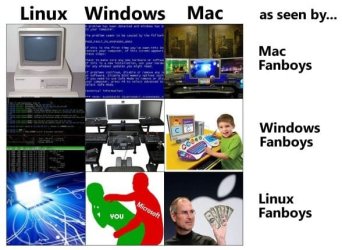
No, he means businesses and organizations that rely on Microsoft support and patches will either have to pay (quite handsomely) for the privilege of continuing to receive security updates, or they'll have to upgrade to continue receiving support and patches for their client OSes. Smaller orgs might be OK running XP for awhile after that, but the larger the business the more risk that is - businesses are risk-averse, and they can't do it all themselves. Running a supported OS version is actually important. Home users in general will mostly be on Vista or Win7 (or even Win8) at that point anyway, and the diehard stragglers will become a lot like the Win98 and Win2K crowds are right now - small, vocal, but ultimately unimportant to the computing world at large.What do you mean "XP dies on April 8, 2014"? Is Microsoft going to make all Windows XP computers spontaneously combust then? Or are they going to steal every single one out of the homes of millions?
Really? Windows 7 was the fastest selling Microsoft OS of all time, and in 2 years has likely sold almost more than half as many XP licenses as XP has sold in 12 years, and that trend goes upwards. Taking into account there was virtually no sales competition from Vista from 2006 - 2009, you're comparing 2 years to almost 12 - Windows 7 is, in fact, the best selling Microsoft OS if we look at reality. Also, excluding China and parts of the far east of Asia (where piracy is rampant), Win7 is now in use on more internet-connected PCs than XP (or will overtake by years' end). By all measurable accounts, 7 *is* selling and being used more than XP, in far shorter timeframes. Really that is no slap against XP either, as (as of service pack 2, anyway) it was a great OS, but Windows 7 does have more features, runs better on today's hardware, and will be supported by the vendor longer into the future (until 2019, to be exact). It's more secure, better to develop for, and has far more options for manageability by IT departments to boot - it actually does help pay for itself when purchased and used en masse in corporate settings (which is where the real long-term money is, something Apple will find out soon enough); that means that, long term, the OS to beat is Windows 7, not XP.And, you might not want to hear this, but it's true: XP is the best selling Microsoft os. 7 doesn't even come close.
If you're going by market cap, yes - Apple is bigger than Microsoft. If you're going by installed base, actual cash on hand, research and development spending, or projected sales, that's still Microsoft and will be for quite some time. "Windows 8" may still be a commercial success (hard to tell from a developer preview, let's be honest), and Microsoft *must* get into the portable device market with a full-blown OS. Even if they don't corner the market until "Windows 9", they will still do so. Without i-devices, Apple's profits are quite small; the lion's share of Apple's cash flow and mindshare are iPhones, iPads, and to a (much) lesser extent, iPods. Microsoft wants to compete there, and it's highly likely they will (which software vendor can get hardware vendors to bend to it's desires? Hint, it's not Apple).Microsoft is now the number 2 computer company. Steve Zuckerburg called Microsoft "the underdog". Apple beat them, which meansthe apocalypseFailure de Grande.
Windows 8 is the child of a design mantra at Microsoft (Metro), which the XBox360, Windows Phone, and now the client OS are following. WinPhone is still based on WinCE, and the 360 is a custom OS that resembles Windows in that it uses DirectX and can be designed for using Visual Studio, but not much more. So while they all have similar design mantras, they're not even really siblings at this point - more distant cousins released by the same family tree. As to the same code, Vista is built from 2003, not XP, and Longhorn was rebooted at least once (to switch from XP to the 2003 codebase, and rewrite the driver model). The code is pretty vastly different between all 3, especially with the minwin design goals - just because the Win32 API doesn't change much between Vista and 7 doesn't mean they're the same code - that's the beauty behind Win32 in the first placeWindows 8 is the child of Windows Phone 7 and Windows Vista. Here's a fact for you: Microsoft is repeating itself. Here's how: Windows Longhorn -> Windows Vista -> Windows Server 2008 -> Windows 7 -> Windows 8. These systems ALL use the same code.
 .
.
Last edited:
My Computer
- Computer type
- PC/Desktop
- Computer Manufacturer/Model Number
- Custom
- OS
- Windows 10 Pro x64
- CPU
- Intel Core i7 4790K @ 4.5GHz
- Motherboard
- Asus Maximus Hero VII
- Memory
- 32GB DDR3
- Graphics Card(s)
- Nvidia GeForce GTX970
- Sound Card
- Realtek HD Audio
- Screen Resolution
- 1920x1200
- Hard Drives
- 1x Samsung 250GB SSD
4x WD RE 2TB (RAIDZ)
- PSU
- Corsair AX760i
- Case
- Fractal Design Define R4
- Cooling
- Noctua NH-D15