SSD Alignment

Problem description

The traditional rotating disks are divided into physical sectors. The Windows operating systems and their components operate according to this sector logic. Despite the fact that SSDs store the data in a completely different way, they are still being treated with this sector logic.

The alignment of the SSD is required to assure that a logical sector starts exactly at the beginning of a physical page of the SSD. Without the alignment, the sector boundaries and the page boundaries will not match and sectors will span pages. That would require for a Windows write operation to clear two blocks in lieu of only one thus reducing the write speed by 50%.

Situation

If you install Windows7 on a brand new SSD, you need not make any special arrangements because the Windows7 installer will do the alignment for you. For Vista you are lucky because the start sector happens to match a SSD page. For XP the start sector is 126 which would be in the middle of a SSD page, thus a prior alignment is required.
A similar situation is present when you clone an existing OS (including Windows7) on a new SSD.

Solution

The easiest way to align an SSD is to create an aligned partition on the SSD with the help of Diskpart. Open an elevated command prompt and run the following sequence of commands – each line followed by Enter.

Diskpart
List disk
Select disk n (where n is the number that was given for your SSD in List disk)
Clean
Create partition primary align=1024
Format fs=ntfs quick
Active (assuming you want to install an OS)
Exit

Note: If you want to create a 100MB partition with alignment, the create command is:

Create partition primary size=100 align=1024

The size unit is always MB.

Verification

If you want to verify the alignment (e.g. for a SSD where you are not certain whether the proper alignment was done), you use the following commands.

Diskpart
List disk
Select disk n (where n is the number that was given for your SSD in List disk)
List partition

Now you should see a result like this.

Partition ### Type Size Offset
------------- ---------------- ------- -------
Partition 1 Primary 59 GB 1024 KB - but 64KB or any number divisible by 4 is also good

The offset (in KBs) has to be divisible by 4.


Note: Some readers and users of this tutorial got confused because the alignment numbers in a typical Windows7 installation are shown as:

1024KB for the 100MB partition
101MB for the next partition - which is most likely the C partition

They think that 101MB is not divisible by 4 and that there must be a problem. But that is not so. If you convert 101MBs into KBs (multiply by 1024), then the number is divisible by 4 and the partition is aligned.


Last edited by a moderator:
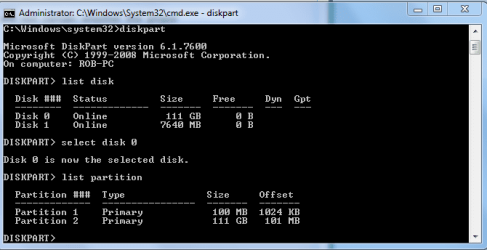
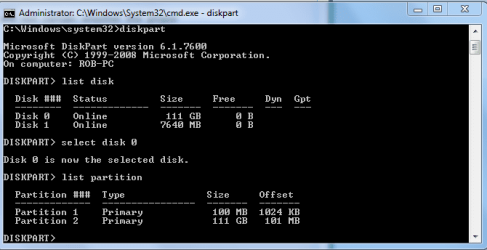
I have a question, mine shows the 100MB mini default partition as the one with the 1024KB offset, and the 111GB partition having 101MB offset, it did this all by default. Is this right or not?

It seems like the larger 111GB partition should be the one with the 1024 offset? I'm not sure if this matters or not.
 

Attachments

  • SSD Partition alignment.PNG
    SSD Partition alignment.PNG
    11.2 KB · Views: 121,989

My Computer

Computer type
PC/Desktop
Computer Manufacturer/Model Number
Home built
OS
Windows 7 Ult, Windows 8.1 Pro,
CPU
Q9650-4.275GHz, E8600 4.5GHz, E6750-3.8GHz
Motherboard
Evga 780i FTW
Memory
G.Skill PC2 9600 1200Mhz 5 5 5 15 2T
Graphics Card(s)
GTX480
Sound Card
Asus Xonar D2
Monitor(s) Displays
HannsG
Screen Resolution
1680X1050
Hard Drives
GSkill Phoenix Pro 120GB SSD
PSU
ThermalTake Toughpower 1000Watt modular
Case
ThermalTake XaserV
Cooling
Xigmatek S1283
Keyboard
Logitech G15
Mouse
Logitech G9
Internet Speed
T1
The only program I know that will align a partition without disturbing the data is from Paragon ( Paragon Alignment Tool - Overview ). But they want $30 and I did not see a trial.
But it seems to be pretty common that the second partition on a SSD is not properly aligned - which, of course, is not good. But with Diskpart, you can only align the whole volume.
 

My Computer

Computer Manufacturer/Model Number
HP, Dell, Gateway, Toshiba - 4 laptops and 2 desktops
OS
Vista, Windows7, Mint Mate, Zorin, Windows 8
CPU
from 1.6GHz Duo to i7
Monitor(s) Displays
2x HP w2207
Hard Drives
5x HDD, 7x SSD, 12x Externals
Keyboard
with trackball - no mices
Mouse
Trackball mice
Internet Speed
DSL 6000
I dunno about lucky, whs.

MS deliberately set Vista alignment that way.

Unless you want to shell out for PAT ( works very well, btw ), you could try this:

Image your main partition with macrium/paragon.

Delete the main partition with diskpart from 7 dvd.

Create new main partition with alignment you want - still using Diskpart.

Restore the image you made to that new partition.

See if the alignment is retained - I expect it will be.

Before you do that- you need to ask:

If 1024 is divisible by 4, is 101 x 1024 also divisible by 4 ?
 

My Computers

System One System Two

  • Computer type
    PC/Desktop
    OS
    7 X64
    CPU
    i5 8400
    Motherboard
    gigabyte b365m ds3h
    Memory
    2x8gb 3200mhz
    Hard Drives
    various
    PSU
    pure power 11 400w cm
    Case
    Coolermaster
    Cooling
    cryorig m9i
  • Computer type
    PC/Desktop
    OS
    7x64
    CPU
    g5400
    Motherboard
    ga b365m ds3h
    Memory
    8gb ddr4 2400
    PSU
    xfx pro 450w
1024 multiplied with any number is divisible by 4. But what does that tell me? Are you suggesting that the 101 offset of the second partition is OK?
 

My Computer

Computer Manufacturer/Model Number
HP, Dell, Gateway, Toshiba - 4 laptops and 2 desktops
OS
Vista, Windows7, Mint Mate, Zorin, Windows 8
CPU
from 1.6GHz Duo to i7
Monitor(s) Displays
2x HP w2207
Hard Drives
5x HDD, 7x SSD, 12x Externals
Keyboard
with trackball - no mices
Mouse
Trackball mice
Internet Speed
DSL 6000
I will say that my write speeds are up there with what everyone else shows. The SSD works flawlessy, not to mention all my WEI scores "winsat SSD test" were in the mid to high 7's.

I would think that Windows 7 would get this right since it's a default installation on a new SSD.

1024*101= 103,424/4= 25,856

It would seem silly if I needed to omit the 100MB boot partition just to get the alignment right.

Windows should be getting this right by default because it was made to work with SSD's.

After doing some reading I found out that in fact Windows did get right by starting the alignment with the 100MB boot partition.

It has to be a multiple of 64. that is 64,128...1024,2048 etc.
Very crudely put, SSD write in 64 blocks. If your alignment is 63 (as set by Acronis) each write/read will span two blocks etc. Hence the so called 50% inefficiency.

For example, if you do a freah install of Win 7 on a fresh SSD, Win 7 will create a initial partition of 100MB with the correct alignment. all subsequent partitions (C Drive etc.) will follow this initial partition set in full MB multiples- hence preserving the 64bit multiple alignment/ offset.
I have attached a copy of my properly aligned/offset SSD drive.
AttachmentSizeSSDOffset.jpg

From the Acronis site.> Is everyone exaggerating the steps for SSD alignment when upgrading to an SSD? | Knowledge Base
 

Attachments

  • SSD Partition alignment.PNG
    SSD Partition alignment.PNG
    11.2 KB · Views: 120,139
Last edited:

My Computer

Computer type
PC/Desktop
Computer Manufacturer/Model Number
Home built
OS
Windows 7 Ult, Windows 8.1 Pro,
CPU
Q9650-4.275GHz, E8600 4.5GHz, E6750-3.8GHz
Motherboard
Evga 780i FTW
Memory
G.Skill PC2 9600 1200Mhz 5 5 5 15 2T
Graphics Card(s)
GTX480
Sound Card
Asus Xonar D2
Monitor(s) Displays
HannsG
Screen Resolution
1680X1050
Hard Drives
GSkill Phoenix Pro 120GB SSD
PSU
ThermalTake Toughpower 1000Watt modular
Case
ThermalTake XaserV
Cooling
Xigmatek S1283
Keyboard
Logitech G15
Mouse
Logitech G9
Internet Speed
T1
What about an ssd raid 0. Of course you break the raid and follow the tut that the barefoot kid wrote and completely erase them with diskpart, then what before you combine the two ssd's, do you align them first or after you create the raid? My raid 0 is rating a 7.8 on the wei scale as of now but I'm not sure know after reading this that I have doubts now.
 

My Computer

Computer Manufacturer/Model Number
Alienware
OS
Windows 7 Ultimate x64
CPU
I7
Motherboard
GA-X58-USB3
Memory
6 x 1.5V DDR3 DIMM sockets supporting up to 24 GB of system
Graphics Card(s)
GeForce GTX 580
Sound Card
Realtek ALC892 codec 2/4/5.1/7.1-channel
Monitor(s) Displays
NEC Display Solutions E321 Black 32"
Screen Resolution
1366 x 768
Hard Drives
OCZ Colossus LT Series OCZSSD2-1CLSLT1T 3.5" 1TB SATA II MLC Internal Solid State Drive
PSU
XFX Black Edition XPS-850W-BES 850W ATX12V
Case
Antec
Cooling
Zalman
Keyboard
Microsoft
Mouse
Microsoft
seth, I am not 100% certain because I have never aligned a Raid0. But I would say, if you align them independently, you cannot go wrong.
 

My Computer

Computer Manufacturer/Model Number
HP, Dell, Gateway, Toshiba - 4 laptops and 2 desktops
OS
Vista, Windows7, Mint Mate, Zorin, Windows 8
CPU
from 1.6GHz Duo to i7
Monitor(s) Displays
2x HP w2207
Hard Drives
5x HDD, 7x SSD, 12x Externals
Keyboard
with trackball - no mices
Mouse
Trackball mice
Internet Speed
DSL 6000
Thanks whs appreciate the reply I will do that and use disk part after creating the raid to partition the raid for w7...also it makes sense you would do this before joining the two ssd's they would match perfectly, but it would probably be a good idea to do it again when the raid is created because the raid creation destroys all partitions...
 

My Computer

Computer Manufacturer/Model Number
Alienware
OS
Windows 7 Ultimate x64
CPU
I7
Motherboard
GA-X58-USB3
Memory
6 x 1.5V DDR3 DIMM sockets supporting up to 24 GB of system
Graphics Card(s)
GeForce GTX 580
Sound Card
Realtek ALC892 codec 2/4/5.1/7.1-channel
Monitor(s) Displays
NEC Display Solutions E321 Black 32"
Screen Resolution
1366 x 768
Hard Drives
OCZ Colossus LT Series OCZSSD2-1CLSLT1T 3.5" 1TB SATA II MLC Internal Solid State Drive
PSU
XFX Black Edition XPS-850W-BES 850W ATX12V
Case
Antec
Cooling
Zalman
Keyboard
Microsoft
Mouse
Microsoft
I have a question, mine shows the 100MB mini default partition as the one with the 1024KB offset, and the 111GB partition having 101MB offset, it did this all by default. Is this right or not?

It seems like the larger 111GB partition should be the one with the 1024 offset? I'm not sure if this matters or not.

Yesterday I done a fresh windows 7 installation on my 64GB SSD. I was reading and following all these neat tutorials and I found this thread.

After the installation completed I had my os partition with an offset of 101MB. I bought for £15 the Paragon Alignment Tool 2.0 hoping that it could fix the "problem" but actually it just told me everything was fine and the os partition was aligned perfectly. The only drive not aligned was the usb pen.

At the end I asked for a refund (received within 30mins).


Cheers.

L.
 

My Computer

OS
Windows 7 Professional x64
The Paragon program did a perfect job.

It rightly told you the alignment is already correct.
 

My Computers

System One System Two

  • Computer type
    PC/Desktop
    OS
    7 X64
    CPU
    i5 8400
    Motherboard
    gigabyte b365m ds3h
    Memory
    2x8gb 3200mhz
    Hard Drives
    various
    PSU
    pure power 11 400w cm
    Case
    Coolermaster
    Cooling
    cryorig m9i
  • Computer type
    PC/Desktop
    OS
    7x64
    CPU
    g5400
    Motherboard
    ga b365m ds3h
    Memory
    8gb ddr4 2400
    PSU
    xfx pro 450w
If the 100MB partition is aligned correctly, then the next partition (C) is aligned correctly.
 

My Computer

Computer Manufacturer/Model Number
HP, Dell, Gateway, Toshiba - 4 laptops and 2 desktops
OS
Vista, Windows7, Mint Mate, Zorin, Windows 8
CPU
from 1.6GHz Duo to i7
Monitor(s) Displays
2x HP w2207
Hard Drives
5x HDD, 7x SSD, 12x Externals
Keyboard
with trackball - no mices
Mouse
Trackball mice
Internet Speed
DSL 6000
Not sure why he wanted a refund on a program that did a perfect job:confused:
 

My Computers

System One System Two

  • Computer type
    PC/Desktop
    OS
    7 X64
    CPU
    i5 8400
    Motherboard
    gigabyte b365m ds3h
    Memory
    2x8gb 3200mhz
    Hard Drives
    various
    PSU
    pure power 11 400w cm
    Case
    Coolermaster
    Cooling
    cryorig m9i
  • Computer type
    PC/Desktop
    OS
    7x64
    CPU
    g5400
    Motherboard
    ga b365m ds3h
    Memory
    8gb ddr4 2400
    PSU
    xfx pro 450w
Not sure why he wanted a refund on a program that did a perfect job:confused:
I guess he found out that he did not need it - with that program, LOL.
 

My Computer

Computer Manufacturer/Model Number
HP, Dell, Gateway, Toshiba - 4 laptops and 2 desktops
OS
Vista, Windows7, Mint Mate, Zorin, Windows 8
CPU
from 1.6GHz Duo to i7
Monitor(s) Displays
2x HP w2207
Hard Drives
5x HDD, 7x SSD, 12x Externals
Keyboard
with trackball - no mices
Mouse
Trackball mice
Internet Speed
DSL 6000
He wanted to get the job done then wanted his money back cause he didn't need it anymore...ha...I just used diskpart to do mine and it was very easy and effective plus it's free......
 

My Computer

Computer Manufacturer/Model Number
Alienware
OS
Windows 7 Ultimate x64
CPU
I7
Motherboard
GA-X58-USB3
Memory
6 x 1.5V DDR3 DIMM sockets supporting up to 24 GB of system
Graphics Card(s)
GeForce GTX 580
Sound Card
Realtek ALC892 codec 2/4/5.1/7.1-channel
Monitor(s) Displays
NEC Display Solutions E321 Black 32"
Screen Resolution
1366 x 768
Hard Drives
OCZ Colossus LT Series OCZSSD2-1CLSLT1T 3.5" 1TB SATA II MLC Internal Solid State Drive
PSU
XFX Black Edition XPS-850W-BES 850W ATX12V
Case
Antec
Cooling
Zalman
Keyboard
Microsoft
Mouse
Microsoft
Am I OK after 1st partition?

Thanks everyone for this thread. I'd like to ask a clarifying question:

I used Acronis TrueImage to clone my old HDD onto an SSD for my Dell laptop. It placed the first partition (78 MB "OEM") and put that at offset 31 kB, which of course is not evenly divisible by four.

However, all other partitions start in the MB or GB range, all of which will be divisible by four. So, does that mean that I may have minor issues with that first "OEM" partition, whatever that does, but my main C: partition (partition 3 at offset 180MB) is OK? Thanks!
 

My Computer

OS
Windows 7 Professional
You are OK. You probably hardly ever have to access this OEM partition, and if you do, it is not going to make a world of difference.
 

My Computer

Computer Manufacturer/Model Number
HP, Dell, Gateway, Toshiba - 4 laptops and 2 desktops
OS
Vista, Windows7, Mint Mate, Zorin, Windows 8
CPU
from 1.6GHz Duo to i7
Monitor(s) Displays
2x HP w2207
Hard Drives
5x HDD, 7x SSD, 12x Externals
Keyboard
with trackball - no mices
Mouse
Trackball mice
Internet Speed
DSL 6000
Today I got a new Mushkin 60GB SSD. I am not yet sure what I will do with it. All my PCs have SSDs already. I bought it because $69.95 was an intriguing price.

In order to be able to do anything with it, I defined a primary active partition with Disk Management on it. To my surprise, Disk Management made a perfect 1024 alignment. So no need to do it with Diskpart any more.
 

My Computer

Computer Manufacturer/Model Number
HP, Dell, Gateway, Toshiba - 4 laptops and 2 desktops
OS
Vista, Windows7, Mint Mate, Zorin, Windows 8
CPU
from 1.6GHz Duo to i7
Monitor(s) Displays
2x HP w2207
Hard Drives
5x HDD, 7x SSD, 12x Externals
Keyboard
with trackball - no mices
Mouse
Trackball mice
Internet Speed
DSL 6000
Yes diskmgmt has always done that, since Vista anyway.
 

My Computers

System One System Two

  • Computer type
    PC/Desktop
    OS
    7 X64
    CPU
    i5 8400
    Motherboard
    gigabyte b365m ds3h
    Memory
    2x8gb 3200mhz
    Hard Drives
    various
    PSU
    pure power 11 400w cm
    Case
    Coolermaster
    Cooling
    cryorig m9i
  • Computer type
    PC/Desktop
    OS
    7x64
    CPU
    g5400
    Motherboard
    ga b365m ds3h
    Memory
    8gb ddr4 2400
    PSU
    xfx pro 450w

My Computer

Computer Manufacturer/Model Number
HP, Dell, Gateway, Toshiba - 4 laptops and 2 desktops
OS
Vista, Windows7, Mint Mate, Zorin, Windows 8
CPU
from 1.6GHz Duo to i7
Monitor(s) Displays
2x HP w2207
Hard Drives
5x HDD, 7x SSD, 12x Externals
Keyboard
with trackball - no mices
Mouse
Trackball mice
Internet Speed
DSL 6000
Back
Top