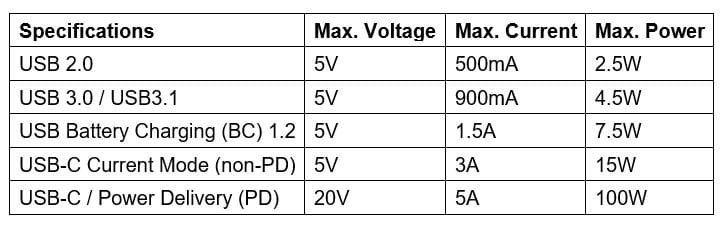
It's 5 volts and 500 mA (Milliamps) for a computer. That amp part (current) is typical for computers in that it's 500 mA. So that's why you may need a good, reputable USB powered hub to provide more USB ports allotting more Amps.
That's on the output side of things. On the input for a powered USB hub, that wall wart adapter could be consuming 2 Amps! In the U.S. we use 120 volts. So the wattage formula is volts * Amps = watts. 120 * 2 is 240 watts. So that powered USB hub could be consuming the equivalent of two 100 watt light bulbs and a 40 watt light bulb. Just keep that in mind because if you have lots of electronics on the same circuit and a space heater you'll come close to popping the breaker since they are mostly rated at 15 Amps per room in the U.S. Some as little as 10 Amps before the breaker trips.
Moving along. The USB wall wart adapters for phones, tablets and lots of of consumer electronics output 5 volts, but depending on the needs of the device being charged have a certain Amp output. Usually around 2 Amps on the output. Enough to charge a tablet. You can see the input and output current and voltage on the adapter its self.
Keep in mind that you don't want to charge a phone or what ever with a cheap USB cable or an under powered USB wall adapter. It'll first cause the adapter to get very warm since the device is pulling all the current possible, and it could damage your device. You just want to make sure you have more than enough Amps on the output side.
They sell small battery charges for USB devices. I have a couple. My Tripp-Lite is rated at over 10,000 mAH (10AH Amp Hours). Looks kinda like
this. Not the same model. Which means I can pull an Amp per hour for 10 hours. So I should be able to charge my phone at least 10 times. But that's just approximate.
In Windows XP you could see how much current the USB bus was currently consuming in Amps by going to the device manager and into the USB devices. Doesn't appear Windows 7 has that.
You might be interested in my video here:
How to tell if a USB phone cable is genuine - YouTube
- - - Updated - - -
An analogy for Amps and Voltage is this:
Think of electricity like a river. The amount of water flow is like Amps. The pressure of that water is like Voltage.
So for Amps it's a Coulomb per second or 1 Amp per second which is equal to the charge of 6.241 x 10[SUP]18[/SUP] protons. LOL For water your flow rate (amount per time) would be like gallons per hour. Or gallons per minute. Or Kilograms per hour. Or even cubic feet per hour. You get the point that Amps are a flow measured with time, a "rate."
You have a rate of possible delivery and a rate of consumption.
Even applies to economics and the freaking post office! LOL